Event submissions
EventsThe 2nd International Electronic Conference on Medicinal Chemistry and Pharmaceutics
Published
This submission belongs to the session S4. Natural Products and Biopharmaceuticals of the event The 2nd International Electronic Conference on Medicinal Chemistry and Pharmaceutics
Published date
28 Oct, 2026
Academic Editor
 Maria Emília Sousa
Contribution&Funding
Conceptualization,
[Chouiteh Amani ] ; [Manel Zitouni]
Methodology,
[Chouiteh Amani ] ; [Manel Zitouni]
Formal analysis,
[Manel Zitouni]
Investigation,
[Chouiteh Amani ] ; [Manel Zitouni]
Data curation,
[Chouiteh Amani ] ; [Manel Zitouni]
Writing - original draft,
[Chouiteh Amani ] ; [Manel Zitouni]
Funding: None
Citation
Yuva BELLIK , Chouiteh Amani , Manel Zitouni, Protective Effects of Rosmarinus officinalis and Artemisia herba-alba Against Glucose-Induced Oxidative Stress in Human Serum: An In Vitro Study, in Proceedings of The 2nd International Electronic Conference on Medicinal Chemistry and Pharmaceutics, 1 November–30 November 2026, MDPI: Basel, Switzerland
Share
Email
Facebook
Twitter
LinkedIn
Protective Effects of Rosmarinus officinalis and Artemisia herba-alba Against Glucose-Induced Oxidative Stress in Human Serum: An In Vitro Study

Yuva BELLIK 1

Chouiteh Amani 1
Manel Zitouni 1
1. Department of Biological Sciences, Faculty of Nature and Life Sciences and Earth and Universe Sciences, Mohamed El Bachir El Ibrahimi University, Bordj Bou Arreridj, Bordj Bou Arreridj, 34000, Algeria
Abstract
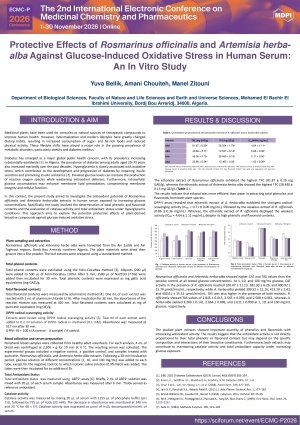
Hyperglycemia is associated with impaired redox homeostasis and enhanced oxidative stress. This study aimed to evaluate the phytochemical composition and antioxidant activity of Rosmarinus officinalis and Artemisia herba-alba extracts and to investigate their protective effects against glucose-induced oxidative stress in human serum under in vitro conditions. Total polyphenol content (TPC) was determined using the Folin–Ciocalteu method, while total flavonoid content (TFC) was assessed using the aluminum chloride colorimetric method. Antioxidant activity was evaluated using the DPPH radical-scavenging assay. The protective effects of the extracts were further investigated in human serum samples exposed to increasing glucose concentrations (1, 10, and 100 mg/mL) by measuring total antioxidant status (TAS) and catalase (CAT) activity. Phytochemical analysis revealed that Rosmarinus officinalis showed a higher TPC than Artemisia herba-alba (81.87 ± 0.20 vs. 48.36 ± 5.19 mg GAE/g, respectively), whereas the TFC values were comparable between the two plants (26.32 ± 1.78 and 28.49 ± 0.15 mg QE/g, respectively). The ethanolic extract of Artemisia herba-alba exhibited strong DPPH radical-scavenging activity (IC₅₀ = 0.71 mg/mL), while the aqueous extract of Rosmarinus officinalis also showed notable radical-scavenging activity (IC₅₀ = 0.864 ± 0.36 mg/mL). Both extracts attenuated glucose-induced oxidative disturbances, as reflected by improvements in TAS and CAT activity in human serum samples. These findings indicate that Rosmarinus officinalis and Artemisia herba-alba possess antioxidant properties and may help mitigate glucose-induced oxidative disturbances in human serum.
Keywords
Rosmarinus officinalis
Artemisia herba-alba
oxidative stress
glucose
serum
antioxidant properties
Poster
Poster Bellik - EICMC 2026.pdf
Korean mistletoe (Viscum album L. var. coloratum (Kom.) Ohwi) water extract inhibits viability and matrix invasion of MDA-MB-231 triple-negative breast cancer spheroids in three-dimensional culture
Effects of Morus alba L. and Morus nigra L. Extracts on Memory Performance in a Scopolamine-induced Zebrafish Model