Event submissions
EventsThe 2nd International Electronic Conference on Medicinal Chemistry and Pharmaceutics
Published
This submission belongs to the session S4. Natural Products and Biopharmaceuticals of the event The 2nd International Electronic Conference on Medicinal Chemistry and Pharmaceutics
Published date
28 Oct, 2026
Academic Editor
 Alfredo Berzal-Herranz
Contribution&Funding
Methodology,
[Maria Crina Isac]
Funding: --
Citation
Alexandra-Mara Cimpanu, Lucian Hritcu, Maria Crina Isac, Effects of Morus alba L. and Morus nigra L. Extracts on Memory Performance in a Scopolamine-induced Zebrafish Model, in Proceedings of The 2nd International Electronic Conference on Medicinal Chemistry and Pharmaceutics, 1 November–30 November 2026, MDPI: Basel, Switzerland
Share
Email
Facebook
Twitter
LinkedIn
Effects of Morus alba L. and Morus nigra L. Extracts on Memory Performance in a Scopolamine-induced Zebrafish Model

Alexandra-Mara Cimpanu 1

Lucian Hritcu 1

Maria Crina Isac 1
1. Biology, Alexandru Ioan Cuza University of Iasi, Iasi, 700506, Romania
Abstract
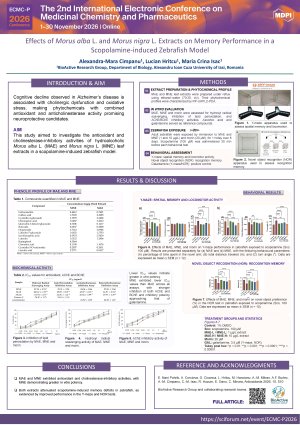
Introduction: Cognitive decline observed in Alzheimer’s disease is associated with cholinergic dysfunction and oxidative stress, making phytochemicals with combined antioxidant and anticholinesterase activity promising neuroprotective candidates. This study investigated the cognitive potential of hydroalcoholic Morus alba L. (MAE) and Morus nigra L. (MNE) leaf extracts in a scopolamine-induced zebrafish model.
Methods: MAE and MNE were phytochemically characterized by RP-UHPLC-PDA. The effects of MAE and MNE (1 and 10 µg/L) were evaluated against scopolamine (100 µM)-induced memory impairment in a zebrafish model (Danio rerio). Memory performance was assessed using the Y-maze and novel object recognition (NOR) paradigms, with galantamine (3.5 µM) serving as the reference compound. The antioxidant and anticholinesterase properties of the extracts were also assessed through hydroxyl radical scavenging and lipid peroxidation inhibition assays, to correlate the biochemical profile with the observed cognitive outcomes.
Results: RP-UHPLC-PDA profiling identified chlorogenic, caffeic and trans-ferulic acids, hyperoside and luteolin-7-glucoside among the most important compounds quantified in the extracts, with MNE exhibiting a higher overall polyphenol content. In the zebrafish model, scopolamine administration induced cognitive impairment, reflected by decreased exploratory preference in both the Y-maze and NOR tests. Treatment with Morus extracts improved memory performance, increasing responses to the novel arm in the Y-maze and preference for the novel object in the NOR test. MNE exhibited stronger antioxidant and cholinesterase-inhibitory activity than MAE.
Conclusions: These findings support MAE and MNE as multi-target neuroprotective candidates, combining behavioral efficacy with a favorable antioxidant and anticholinesterase profile.
Keywords
Morus alba
Morus nigra
zebrafish
scopolamine
memory
Poster
MDPI_Alexandra-Mara_Cimpanu.pdf
Protective Effects of Rosmarinus officinalis and Artemisia herba-alba Against Glucose-Induced Oxidative Stress in Human Serum: An In Vitro Study
DESIGN AND IN VITRO FUNCTIONAL EVALUATION OF M-6HIS-GLP-1-6HIS, A DUAL-HEXAHISTIDINE-TAGGED GLP-1 VARIANT