Event submissions
EventsThe 2nd International Electronic Conference on Medicinal Chemistry and Pharmaceutics
Published
This submission belongs to the session S5. Novel Methodologies and AI of the event The 2nd International Electronic Conference on Medicinal Chemistry and Pharmaceutics
Published date
28 Oct, 2026
Academic Editor
 Maria Emília Sousa
Citation
Ifeoluwa Kehinde Bamidele, Objective-Specific Measurement Selection for Mechanistic Assessment of Pharmaceutical UVC Degradation, in Proceedings of The 2nd International Electronic Conference on Medicinal Chemistry and Pharmaceutics, 1 November–30 November 2026, MDPI: Basel, Switzerland
Share
Email
Facebook
Twitter
LinkedIn
Objective-Specific Measurement Selection for Mechanistic Assessment of Pharmaceutical UVC Degradation

Ifeoluwa Kehinde Bamidele 1
1. Chemistry , Dominican University, Ibadan, Nigeria , Ibadan, 200213, Nigeria
Abstract
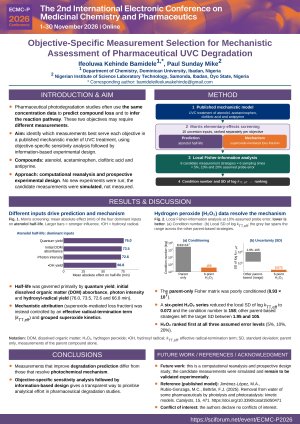
Background: Pharmaceutical photodegradation studies often use the same concentration data to predict compound loss and to infer the responsible reaction pathway, although these two objectives may require different measurements. Methods: We evaluated a published mechanistic model for UVC treatment of atenolol, acetaminophen, clofibric acid, and antipyrine. Morris elementary-effects screening ranked ten uncertain inputs separately for atenolol half-life and its superoxide-mediated loss fraction. Local Fisher-information analysis then compared eight candidate measurement strategies at six sampling times under 5%, 10%, and 20% assumed probe error. Results: Half-life was governed primarily by quantum yield, initial dissolved organic matter absorbance, photon intensity, and hydroxyl-radical yield, with mean absolute effects of 76.0, 73.5, 72.6, and 66.8 min, respectively. Mechanistic attribution was instead controlled by an effective radical-termination term and grouped superoxide kinetics. The parent-only Fisher matrix was poorly conditioned (8.93 x 10^7). At 10% assumed error, a six-point hydrogen peroxide series reduced the local standard deviation of log kTT,eff to 0.072 and the condition number to 158; additional parent-based strategies left the target standard deviation between 1.95 and 105. Hydrogen peroxide ranked first at all three assumed error levels. Conclusions: Measurements that improve degradation prediction differ from those that resolve photochemical mechanism. Objective-specific sensitivity analysis followed by information-based design provides a transparent method for prioritizing analytical effort in pharmaceutical degradation studies. The proposed measurements remain to be validated experimentally.
Keywords
pharmaceutical photodegradation; model-based experimental design; global sensitivity analysis; practical identifiability; reactive oxygen species; UVC
Poster
ECMCP2026_poster_Bamidele .pdf
Computational Evaluation of Natural Polyphenols from Cistus creticus as Multitarget Antioxidants: Docking, PASS Prediction, and Pharmacokinetic Study
Multimodal Graph Neural Network and Natural Language Processing Model for Antileishmanial Molecule Screening