Event submissions
EventsThe 2nd International Electronic Conference on Medicinal Chemistry and Pharmaceutics
Published
This submission belongs to the session S5. Novel Methodologies and AI of the event The 2nd International Electronic Conference on Medicinal Chemistry and Pharmaceutics
Published date
28 Oct, 2026
Academic Editor
 Mary J. Meegan
Contribution&Funding
Conceptualization,
[Glay Chinea Santiago] ; [Yailé Caballero Mota] ; [Oscar Guillermo Collado García] ; [Yanela Rodríguez Alvarez]
Methodology,
[Oscar Guillermo Collado García] ; [Glay Chinea Santiago] ; [Yailé Caballero Mota] ; [Yanela Rodríguez Alvarez]
Software,
[Glay Chinea Santiago] ; [Yanela Rodríguez Alvarez] ; [Yailé Caballero Mota] ; [Angel Miguel Palmero Rodríguez]
Validation,
[Yailé Caballero Mota] ; [Yanela Rodríguez Alvarez]
Formal analysis,
[Yailé Caballero Mota] ; [Oscar Guillermo Collado García] ; [Yanela Rodríguez Alvarez]
Investigation,
[Angel Miguel Palmero Rodríguez] ; [Oscar Guillermo Collado García]
Resources,
[Yailé Caballero Mota] ; [Yanela Rodríguez Alvarez] ; [Glay Chinea Santiago]
Data curation,
[Yailé Caballero Mota] ; [Yanela Rodríguez Alvarez]
Writing - original draft,
[Yailé Caballero Mota] ; [Glay Chinea Santiago] ; [Oscar Guillermo Collado García] ; [Yanela Rodríguez Alvarez] ; [Angel Miguel Palmero Rodríguez]
Writing - review,
[editing] ; [Oscar Guillermo Collado García] ; [Yanela Rodríguez Alvarez] ; [Yailé Caballero Mota]
Visualization,
[Yanela Rodríguez Alvarez] ; [Yailé Caballero Mota] ; [Oscar Guillermo Collado García]
Supervision,
[Glay Chinea Santiago] ; [Yanela Rodríguez Alvarez] ; [Yailé Caballero Mota] ; [Oscar Guillermo Collado García]
Project administration,
[Yailé Caballero Mota] ; [Glay Chinea Santiago]
Funding acquisition,
[Yailé Caballero Mota]
Funding: --
Citation
Oscar Guillermo Collado García, Angel Miguel Palmero Rodríguez, Yanela Rodríguez Alvarez, Yailé Caballero Mota, Glay Chinea Santiago, Identification of amino acids associated with the agonist and antagonist activities of flavonoids in the PAS-B cavity of the aryl hydrocarbon receptor using molecular docking modeling and artificial intelligence techniques., in Proceedings of The 2nd International Electronic Conference on Medicinal Chemistry and Pharmaceutics, 1 November–30 November 2026, MDPI: Basel, Switzerland
Share
Email
Facebook
Twitter
LinkedIn
Identification of amino acids associated with the agonist and antagonist activities of flavonoids in the PAS-B cavity of the aryl hydrocarbon receptor using molecular docking modeling and artificial intelligence techniques.

Oscar Guillermo Collado García 1
Angel Miguel Palmero Rodríguez 2
Yanela Rodríguez Alvarez 2
Yailé Caballero Mota 2
Glay Chinea Santiago 3
1. Department of Chemistry, Faculty of Applied Sciences, University of Camagüey, Camagüey , 74650, Cuba
2. Department of Computer Science, Faculty of Computer Science and Exact Sciences. University of Camagüey, Camagüey , 74650, Cuba
3. Bioinformatics Group, Center for Genetic Engineering and Biotechnology, Havana , Cuba
Abstract
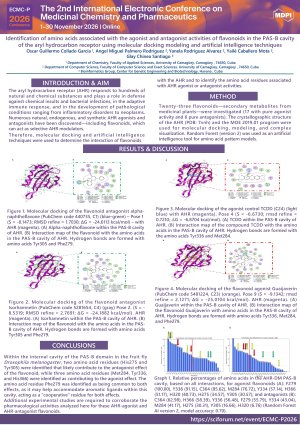
The aryl hydrocarbon receptor (AHR) responds to hundreds of natural and chemical substances and plays a role in defense against chemical insults and bacterial infections, in the adaptive immune response, and in the development of pathological conditions ranging from inflammatory disorders to neoplasms. Numerous natural, endogenous, and synthetic AHR agonists and antagonists have been discovered—including flavonoids, which can act as selective AHR modulators. Therefore, molecular docking and artificial intelligence techniques were used to determine the interaction of flavonoids with the AHR and to identify the amino acid residues associated with AHR agonist or antagonist activities. Twenty-three flavonoids—secondary metabolites from medicinal plants—were investigated (17 with pure agonist activity and 6 pure antagonists). The crystallographic structure of the AHR (PDB: 7vnh) and the MOE 2019.01 program were used for molecular docking, modeling, and complex visualization. Random Forest (version 2) was used as an artificial intelligence tool for amino acid pattern models. Conserved amino acid residues (Tyr, Phe, and His) were identified; given their conservation, they likely play specific roles within the PAS-B domain cavity of the Drosophila melanogaster AHR. The following amino acid residues could contribute to flavonoid binding: His275, Phe279, Met284, Tyr305, Tyr336, and His366. His275 and Tyr305 are associated with antagonist activity, whereas Met284, Tyr336, and His366 are associated with agonist activity. Phe279 is common to both agonist and antagonist activities of flavonoids at the AHR.
Keywords
Antitumorals; Artificial intelligence; Aryl hydrocarbon receptor; Flavonoids; Molecular docking.
Poster
Poster Sciforum-211602 OCollado et al 2026.pdf
Multimodal Graph Neural Network and Natural Language Processing Model for Antileishmanial Molecule Screening
Data-driven identification of potential multi-target antifungal agents for deep mycoses via machine learning and structural modeling