Event submissions
EventsThe 2nd International Electronic Conference on Medicinal Chemistry and Pharmaceutics
Published
This submission belongs to the session S5. Novel Methodologies and AI of the event The 2nd International Electronic Conference on Medicinal Chemistry and Pharmaceutics
Published date
28 Oct, 2026
Academic Editor
 Maria Emília Sousa
Contribution&Funding
Conceptualization,
[Roberto Pontarolo] ; [Dile Pontarolo Stremel] ; [Raul Edison Luna Lazo] ; [Gustavo Henrique Scheiffer] ; [Henrique Gabriel Wuchryn Martins] ; [Moisés Maia Neto]
Methodology,
[Henrique Gabriel Wuchryn Martins] ; [Gustavo Henrique Scheiffer] ; [Moisés Maia Neto]
Software,
[Gustavo Henrique Scheiffer] ; [Moisés Maia Neto]
Validation,
[Raul Edison Luna Lazo]
Formal analysis,
[Henrique Gabriel Wuchryn Martins]
Investigation,
[Moisés Maia Neto] ; [Gustavo Henrique Scheiffer] ; [Henrique Gabriel Wuchryn Martins]
Resources,
[Bernardo Mussa] ; [Roberto Pontarolo]
Data curation,
[Henrique Gabriel Wuchryn Martins]
Writing - original draft,
[Henrique Gabriel Wuchryn Martins]
Writing - review,
[editing] ; [Moisés Maia Neto] ; [Bernardo Mussa] ; [Raul Edison Luna Lazo] ; [Dile Pontarolo Stremel] ; [Roberto Pontarolo]
Visualization,
[Henrique Gabriel Wuchryn Martins]
Supervision,
[Raul Edison Luna Lazo] ; [Dile Pontarolo Stremel] ; [Roberto Pontarolo]
Funding: The authors express their gratitude to the Brazilian National Council of Technological and Scientific Development (CNPq) and “Coordenação de Aperfeiçoamento de Pessoal de Nível Superior – Brasil” (CAPES) - Finance Code 001.
Citation
Henrique Gabriel Wuchryn Martins, Gustavo Henrique Scheiffer, Moisés Maia Neto, Bernardo Mussa, Raul Edison Luna Lazo, Dile Pontarolo Stremel, Roberto Pontarolo, Data-driven identification of potential multi-target antifungal agents for deep mycoses via machine learning and structural modeling, in Proceedings of The 2nd International Electronic Conference on Medicinal Chemistry and Pharmaceutics, 1 November–30 November 2026, MDPI: Basel, Switzerland
Share
Email
Facebook
Twitter
LinkedIn
Data-driven identification of potential multi-target antifungal agents for deep mycoses via machine learning and structural modeling

Henrique Gabriel Wuchryn Martins 1
Gustavo Henrique Scheiffer 1
Moisés Maia Neto 1
Bernardo Mussa 1

Raul Edison Luna Lazo 1
Dile Pontarolo Stremel 2
Roberto Pontarolo 1
1. Post-Graduate Program in Pharmaceutical Sciences, Universidade Federal Do Paraná, Curitiba, 80210-170, Brazil
2. Department of Forest Engineering and Technology, Universidade Federal Do Paraná, Curitiba, 80210-170, Brazil
Abstract
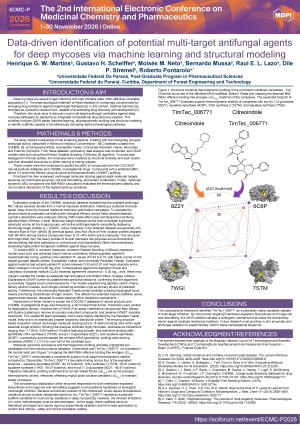
Introduction: Deep mycoses are severe fungal infections affecting subcutaneous or deeper tissues, often with high mortality rates, with opportunistic mycoses affecting over 3 million individuals globally. Additionally, neglected fungal pathogens such as Mucorales, Sporothrix spp., and Histoplasma spp. affect vulnerable populations, and lack adequate reporting systems. The treatment of these diseases is increasingly compromised by emerging drug resistance, highlighting the need for novel therapeutic strategies.
Methods: This study employed a sequential virtual screening pipeline to screen libraries of natural products and investigational drugs. It integrated five biologically grouped QSAR models built using the eXtreme Gradient Boosting (XGBoost) algorithm, followed by pharmacokinetic profiling. Prioritized hits underwent multi-target molecular docking against eight targets and were validated through molecular dynamics (MD) simulations to assess thermodynamic stability.
Results: The virtual screening and subsequent validations identified Citreoindole and TimTec1_006771, from the COCONUT database, as lead candidates. TimTec1_006771 emerged as the superior hit, exhibiting favorable interactions across multiple targets, including squalene epoxidase, squalene synthase, and exo-β-(1,3)-glucanase.
Discussion: Molecular dynamics results suggests that TimTec1_006771 is capable of multi-target inhibition, simultaneously disrupting membrane ergosterol biosynthesis and fungal cell wall remodeling. This suggests a synergistic effect that increases the evolutionary barrier against resistance. Furthermore, these candidates occupy “beyond Rule of Five” (bRo5) chemical space, suggesting that larger, rigid scaffolds may improve anchoring within diverse binding sites.
Conclusion: This research provides a computational framework for developing multi-target therapeutics against fungal pathogens. Future research should prioritize in vitro enzymatic and antifungal validation of these compounds, specially against resistant strains.
Keywords
Cheminformatics
Drug Discovery
Polypharmacology
Drug repurposing
Natural products
Molecular modeling
beyond Rule of 5
Poster
ecmc_p_2026_henrique.pdf
Identification of amino acids associated with the agonist and antagonist activities of flavonoids in the PAS-B cavity of the aryl hydrocarbon receptor using molecular docking modeling and artificial intelligence techniques.
In Silico Evaluation of Escitalopram Derivatives for Alzheimer’s Disease