Event submissions
EventsThe 2nd International Electronic Conference on Medicinal Chemistry and Pharmaceutics
Published
This submission belongs to the session S5. Novel Methodologies and AI of the event The 2nd International Electronic Conference on Medicinal Chemistry and Pharmaceutics
Published date
28 Oct, 2026
Academic Editor
 Maria Emília Sousa
Contribution&Funding
Conceptualization,
[Marina Ž. Vesović]
Methodology,
[Ana S. Živanović] ; [Marina Ž. Vesović] ; [Dušan Lj. Tomović]
Software,
[Nikola V. Nedeljković]
Validation,
[Marina Ž. Vesović] ; [Nikola V. Nedeljković] ; [Gordana P. Radić]
Formal analysis,
[Gordana P. Radić]
Investigation,
[Miloš V. Nikolić] ; [Andriana M. Bukonjić] ; [Dušan Lj. Tomović]
Writing - original draft,
[Ana S. Živanović]
Visualization,
[Andriana M. Bukonjić]
Supervision,
[Miloš V. Nikolić]
Funding: This research was funded by the Ministry of Science, Technological Development and Innovation of the Republic of Serbia through Grant Agreements with the University of Kragujevac-Faculty of Medical Sciences No: 451-03-34/2026-03/ 200111.
Citation
Ana S. Živanović, Marina Ž. Vesović, Nikola V. Nedeljković, Miloš V. Nikolić, Andriana M. Bukonjić, Dušan Lj. Tomović, Gordana P. Radić, In Silico Evaluation of Escitalopram Derivatives for Alzheimer’s Disease, in Proceedings of The 2nd International Electronic Conference on Medicinal Chemistry and Pharmaceutics, 1 November–30 November 2026, MDPI: Basel, Switzerland
Share
Email
Facebook
Twitter
LinkedIn
In Silico Evaluation of Escitalopram Derivatives for Alzheimer’s Disease

Ana S. Živanović 1,2
Marina Ž. Vesović 1,2

Nikola V. Nedeljković 1,2

Miloš V. Nikolić 1,2
Andriana M. Bukonjić 1,2
Dušan Lj. Tomović 1,2
Gordana P. Radić 1,2
1. Department of Pharmacy, Faculty of Medical Sciences, University of Kragujevac, Kragujevac, 34000, Serbia
2. Center for Molecular Medicine and Stem Cell Research, Faculty of Medical Sciences, University of Kragujevac, Kragujevac, 34000, Serbia
Abstract
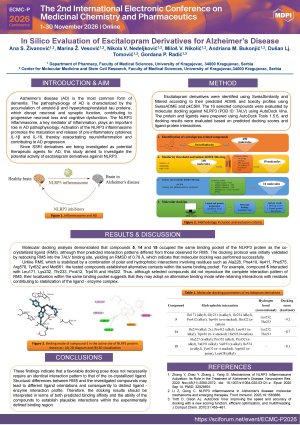
Alzheimer’s disease (AD) is the most common form of dementia. The NLRP3 inflammasome, a key mediator of inflammation, plays an important role in AD pathophysiology. Since SSRI derivatives are being investigated as potential therapeutic agents for AD, this study aimed to investigate the activity of escitalopram derivatives against NLRP3. Escitalopram derivatives were identified using SwissSimilarity and filtered according to their predicted ADME and toxicity profiles using SwissADME and pkCSM. The 16 selected compounds were evaluated by molecular docking against NLRP3 (PDB ID: 7ALV) using AutoDock Vina. The protein and ligands were prepared using AutoDock Tools 1.5.6, and docking results were evaluated based on predicted docking scores and ligand-protein interactions. Molecular docking identified compounds 5, 14, and 15 as the most promising for binding to NLRP3, with docking scores of -9.2, -8.7, and -8.1 kcal/mol, respectively, compared with -9.7 kcal/mol for the co-crystallized ligand RM5. The reliability of the docking protocol was confirmed by redocking the co-crystallized ligand RM5, with an RMSD value of 0.78 Å. Compounds 5, 14, and 15 did not reproduce the same interactions as RM5 but showed favorable interactions within the NLRP3 binding region. Compound 5 established conventional hydrogen bonds with Lys232 and Thr233, a π-cation interaction with His522, a π-π interaction with Trp416, and several hydrophobic interactions. Overall, these results suggest that the selected compounds can interact with NLRP3 through binding modes distinct from RM5, supporting further investigation as potential NLRP3-targeting compounds.
Keywords
Alzheimer’s disease
NLRP3 inflammasome
escitalopram derivatives
molecular docking
Poster
In Silico Evaluation of Escitalopram Derivatives for Alzheimer’s Disease.pdf
Data-driven identification of potential multi-target antifungal agents for deep mycoses via machine learning and structural modeling
Environmentally Friendly HPLC Method for Two Antidiabetic Agents for Simultaneous Estimation