Event submissions
EventsThe 2nd International Electronic Conference on Medicinal Chemistry and Pharmaceutics
Published
This submission belongs to the session S5. Novel Methodologies and AI of the event The 2nd International Electronic Conference on Medicinal Chemistry and Pharmaceutics
Published date
28 Oct, 2026
Academic Editor
 Francisco Javier Otero Espinar
Contribution&Funding
Conceptualization,
[Marwa Hamdy Sayed Dawoud]
Methodology,
[Marwa Hamdy Sayed Dawoud] ; [Mariam Osama Hamza] ; [Kareem Medhat Abdullah Abdelal] ; [Rana Raef Shaker] ; [Ahmed Hussein Mohammed Mohammed]
Software,
[Marwa Hamdy Sayed Dawoud]
Validation,
[Marwa Hamdy Sayed Dawoud]
Formal analysis,
[Marwa Hamdy Sayed Dawoud] ; [Mariam Osama Hamza] ; [Kareem Medhat Abdullah Abdelal] ; [Rana Raef Shaker] ; [Ahmed Hussein Mohammed Mohammed]
Investigation,
[Ahmed Hussein Mohammed Mohammed] ; [Marwa Hamdy Sayed Dawoud]
Resources,
[Marwa Hamdy Sayed Dawoud]
Data curation,
[Mariam Osama Hamza] ; [Marwa Hamdy Sayed Dawoud]
Writing - original draft,
[Mariam Osama Hamza] ; [Ahmed Hussein Mohammed Mohammed] ; [Rana Raef Shaker] ; [Marwa Hamdy Sayed Dawoud] ; [Kareem Medhat Abdullah Abdelal]
Writing - review,
[editing] ; [Mariam Osama Hamza] ; [Kareem Medhat Abdullah Abdelal] ; [Rana Raef Shaker] ; [Marwa Hamdy Sayed Dawoud] ; [Ahmed Hussein Mohammed Mohammed]
Visualization,
[Marwa Hamdy Sayed Dawoud]
Supervision,
[Marwa Hamdy Sayed Dawoud]
Project administration,
[Marwa Hamdy Sayed Dawoud]
Funding: --
Citation
Marwa Hamdy Sayed Dawoud, Ahmed Hussein Mohammed Mohammed, Rana Raef Shaker, Kareem Medhat Abdullah Abdelal, Mariam Osama Hamza, AI-Driven Prediction of Anti-inflammatory Dose Requirements and Treatment Response for Patient-Specific Management of Ulcerative Colitis, in Proceedings of The 2nd International Electronic Conference on Medicinal Chemistry and Pharmaceutics, 1 November–30 November 2026, MDPI: Basel, Switzerland
Share
Email
Facebook
Twitter
LinkedIn
AI-Driven Prediction of Anti-inflammatory Dose Requirements and Treatment Response for Patient-Specific Management of Ulcerative Colitis

Marwa Hamdy Sayed Dawoud 1
Ahmed Hussein Mohammed Mohammed 1
Rana Raef Shaker 1
Kareem Medhat Abdullah Abdelal 1
Mariam Osama Hamza 1
1. Pharmaceutics, MSA University (October University for Modern Sciences and Arts), Giza, 12451, Egypt
Abstract
Background
Ulcerative colitis (UC) is a chronic inflammatory bowel disease characterized by patient heterogeneity and variable therapeutic response. Current treatments remain empirical, while drug repurposing offers a promising strategy to accelerate therapeutic development. Vardenafil, a phosphodiesterase-5 inhibitor with anti-inflammatory potential in UC, represents a model repurposed drug.
Aim
This study aimed to develop AI-based predictive models for patient-specific management of UC, using vardenafil as a model repurposed drug.
Methods
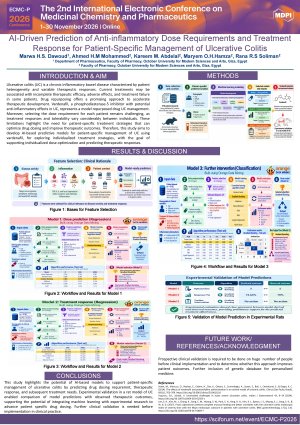
A dataset of 370 patient records retrospectively curated from published UC studies involving different anti-inflammatory therapies. Animal data were converted to human-equivalent data, where applicable. Patient-specific demographic and clinical characteristics, including age, weight, disease duration, smoking status, family history, Mayo score, C-reactive protein, interleukin-6, and fecal calprotectin, were used as predictive variables. Three machine learning models predicted dose requirement (mg/day), treatment response (0-100%), and the subsequent intervention (no action, dose escalation, or surgery). Several machine learning algorithms were tested to select the ones with the least errors. Models were developed using a 70:30 training/testing split, with cross-validation during hyperparameter optimization. Vardenafil was selected as the model repurposed drug, based on preclinical evidence and model-derived predictions were evaluated in a rat model of UC.
Results
Gradient Boosting demonstrated the strongest performance among algorithms, for the three models. Dose prediction achieved R² = 0.984 and RMSE = 0.121 while treatment-response prediction achieved R² = 0.730 and RMSE = 12.976. Prediction of intervention achieved an F1-score of 0.845, precision of 0.834, and recall of 0.868. Experimental evaluation showed close agreement between model-derived and observed outcomes, providing preliminary support for predicted treatment effectiveness.
Conclusion
AI-driven modelling provides a promising approach for patient-specific prediction of anti-inflammatory dose requirements, treatment response and subsequent intervention in UC. However, prospective clinical validation is required before clinical implementation and to determine whether the approach improves patient outcomes.
Keywords
Ulcerative colitis;
Drug repurposing;
Artificial Intelligence
Patient-specific dose prediction;
Machine learning
Poster
Poster AI Conference.pdf
Environmentally Friendly HPLC Method for Two Antidiabetic Agents for Simultaneous Estimation
Reliable Mutagenicity Triage for Early Medicinal Chemistry: Scaffold-Aware Validation of AI Safety Models