Event submissions
EventsThe 2nd International Electronic Conference on Medicinal Chemistry and Pharmaceutics
Published
This submission belongs to the session S5. Novel Methodologies and AI of the event The 2nd International Electronic Conference on Medicinal Chemistry and Pharmaceutics
Published date
28 Oct, 2026
Academic Editor
 Francisco Javier Otero Espinar
Contribution&Funding
Conceptualization,
[Marcin Gackowski]
Methodology,
[Marcin Gackowski]
Software,
[Marcin Gackowski]
Validation,
[Marcin Gackowski]
Formal analysis,
[Michal Janiak] ; [Marcin Gackowski]
Investigation,
[Michal Janiak] ; [Marcin Gackowski] ; [Julia Standarska]
Resources,
[Marcin Gackowski]
Data curation,
[Julia Standarska] ; [Michal Janiak] ; [Marcin Gackowski]
Writing - original draft,
[Julia Standarska] ; [Michal Janiak] ; [Marcin Gackowski]
Writing - review,
[editing] ; [Julia Standarska] ; [Marcin Gackowski]
Visualization,
[Michal Janiak] ; [Marcin Gackowski]
Supervision,
[Marcin Gackowski]
Project administration,
[Marcin Gackowski]
Funding: --
Citation
Michal Janiak, Julia Standarska, Marcin Gackowski, MARSplines-Based QSAR Modeling of Asundexian Derivatives as Factor XIa Inhibitors, in Proceedings of The 2nd International Electronic Conference on Medicinal Chemistry and Pharmaceutics, 1 November–30 November 2026, MDPI: Basel, Switzerland
Share
Email
Facebook
Twitter
LinkedIn
MARSplines-Based QSAR Modeling of Asundexian Derivatives as Factor XIa Inhibitors

Michal Janiak 1,2
Julia Standarska 3

Marcin Gackowski 3
1. Department of Toxicology and Bromatology, Ludwik Rydygier Collegium Medicum in Bydgoszcz, Nicolaus Copernicus University in Torun, , Bydgoszcz, 85-089, Poland
2. Doctoral School of Medical and Health Sciences, Ludwik Rydygier Collegium Medicum, Nicolaus Copernicus University in Toruń, Bydgoszcz, 85-067 , Poland
3. Department of Toxicology and Bromatology, Ludwik Rydygier Collegium Medicum in Bydgoszcz, Nicolaus Copernicus University in Torun, Bydgoszcz, 85-089, Poland
Abstract
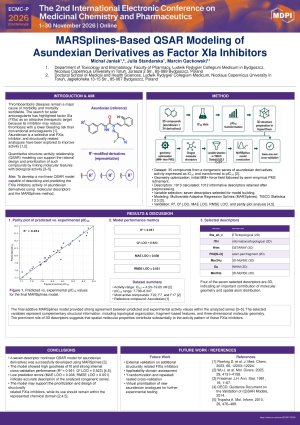
Factor XIa (FXIa) has emerged as an attractive molecular target for the development of anticoagulant agents. The aim of this study was to develop a quantitative structure–activity relationship (QSAR) model describing the inhibitory activity of structurally related asundexian derivatives against FXIa. The analyzed dataset comprised asundexian and 34 derivatives with experimentally reported IC₅₀ values, which were converted to pIC₅₀. Three-dimensional molecular structures were prepared in HyperChem and geometry-optimized using the MM+ force field followed by the semi-empirical PM3 method. Molecular descriptors were subsequently calculated using Dragon. Following preprocessing and variable selection, seven descriptors (Eta_sh_x, ITH, H4m, F04[N–O], Mor24u, Gu, and Mor03s) were used to construct a nonlinear QSAR model with Multivariate Adaptive Regression Splines (MARSplines) implemented in TIBCO Statistica 13.3. The resulting model showed a high goodness of fit (R² = 0.951) and strong internal cross-validation performance (Q²LOO = 0.923), with MAELOO = 0.038 and RMSELOO = 0.051. Four of the seven selected variables were three-dimensional descriptors, suggesting that molecular geometry and spatial atomic distribution contribute relevant information to the activity pattern within this congeneric series. The developed model provides an interpretable computational framework for structure–activity analysis of asundexian derivatives and may support the prioritization of structurally related FXIa inhibitors for further experimental investigation.
Keywords
QSAR; MARSplines; asundexian; factor XIa; molecular descriptors
Poster
ECMC-P_2026_Asundexian_QSAR_EDITABLE_fulltext_graphics_v4.pdf
Bridging a Pharmacopoeial Gap DoE-Optimized RP-HPLC Assay and Dissolution Method Development & Validation for Cefixime–Ofloxacin Fixed-Dose Combination Tablets
Data-driven identification of potential NDM-1 inhibitors using machine learning and large-scale virtual screening.