Event submissions
EventsThe 2nd International Electronic Conference on Medicinal Chemistry and Pharmaceutics
Published
This submission belongs to the session S5. Novel Methodologies and AI of the event The 2nd International Electronic Conference on Medicinal Chemistry and Pharmaceutics
Published date
28 Oct, 2026
Academic Editor
 Mary J. Meegan
Contribution&Funding
Conceptualization,
[Mauricio Galvis Patiño] ; [Lusayda Sanchez-Corrales] ; [Luisa Frenanda Sastoque-Galeano] ; [Yeison Alberto Garcés-Gómez] ; [Eduvan Daniel Valencia-Cristancho]
Methodology,
[Mauricio Galvis Patiño] ; [Luisa Frenanda Sastoque-Galeano] ; [Eduvan Daniel Valencia-Cristancho]
Software,
[Eduvan Daniel Valencia-Cristancho]
Validation,
[Eduvan Daniel Valencia-Cristancho]
Formal analysis,
[Eduvan Daniel Valencia-Cristancho]
Investigation,
[Luisa Frenanda Sastoque-Galeano] ; [Eduvan Daniel Valencia-Cristancho]
Resources,
[Eduvan Daniel Valencia-Cristancho]
Data curation,
[Eduvan Daniel Valencia-Cristancho] ; [Luisa Frenanda Sastoque-Galeano]
Writing - original draft,
[Eduvan Daniel Valencia-Cristancho]
Writing - review,
[editing] ; [Eduvan Daniel Valencia-Cristancho]
Visualization,
[Lusayda Sanchez-Corrales] ; [Luisa Frenanda Sastoque-Galeano] ; [Yeison Alberto Garcés-Gómez] ; [Eduvan Daniel Valencia-Cristancho]
Supervision,
[Mauricio Galvis Patiño] ; [Lusayda Sanchez-Corrales] ; [Yeison Alberto Garcés-Gómez] ; [Eduvan Daniel Valencia-Cristancho]
Project administration,
[Yeison Alberto Garcés-Gómez] ; [Eduvan Daniel Valencia-Cristancho]
Funding acquisition,
[Yeison Alberto Garcés-Gómez]
Funding: --
Citation
Eduvan Daniel Valencia-Cristancho, Yeison Alberto Garcés-Gómez, Mauricio Galvis Patiño, Lusayda Sanchez-Corrales, Luisa Frenanda Sastoque-Galeano, Data-driven identification of potential NDM-1 inhibitors using machine learning and large-scale virtual screening., in Proceedings of The 2nd International Electronic Conference on Medicinal Chemistry and Pharmaceutics, 1 November–30 November 2026, MDPI: Basel, Switzerland
Share
Email
Facebook
Twitter
LinkedIn
Data-driven identification of potential NDM-1 inhibitors using machine learning and large-scale virtual screening.

Eduvan Daniel Valencia-Cristancho 1

Yeison Alberto Garcés-Gómez 2

Mauricio Galvis Patiño 3
Lusayda Sanchez-Corrales 2
Luisa Frenanda Sastoque-Galeano 4
1. Science, Universidad Católica de Manizales, Bogotá, 110821, Colombia
2. Science, Universidad Católica de Manizales, Manizales, 170001, Colombia
3. Science, Fundación Universitaria los Libertadores, Bogotá, 110821, Colombia
4. Technology, Universidad del Desarrollo Empresarial y Pedagógico , Bogotá, 110821, Colombia
Abstract
Antimicrobial resistance is one of the most pressing global health challenges, particularly due to the increasing prevalence of multidrug-resistant Gram-negative bacteria. Among the most clinically relevant resistance mechanisms, the metallo-β-lactamase NDM-1 is of particular concern because of its ability to hydrolyze a broad range of β-lactam antibiotics, including carbapenems. Despite its clinical importance, no clinically approved inhibitor is currently available to effectively target this enzyme.
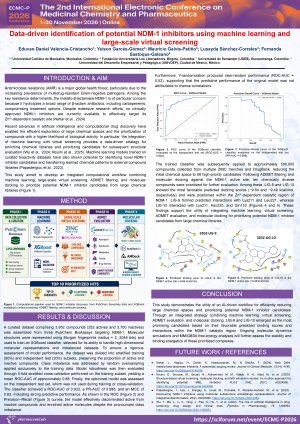
In this study, we developed an integrated computational workflow combining machine learning, large-scale virtual screening, molecular similarity analysis, ADMET profiling, and molecular docking to prioritize potential NDM-1 inhibitor candidates. A curated dataset comprising 3,952 compounds, including 252 active molecules, was assembled from PubChem BioAssays and represented using Morgan fingerprints. An XGBoost classifier was trained and evaluated using stratified cross-validation and an independent test set, achieving strong predictive performance (ROC-AUC = 0.922, PR-AUC = 0.686, MCC = 0.63). Y-randomization experiments further supported model robustness, indicating that the observed predictive performance was not attributable to chance correlations.
The optimized model was subsequently applied as an enrichment filter to approximately 500,000 compounds retrieved from the ZINC and DrugBank databases, reducing the initial chemical space to 98 high-priority candidates. These compounds were further prioritized through Tanimoto-based molecular similarity analysis, ADMET profiling, and molecular docking. D-captopril and meropenem were included as reference compounds to contextualize inhibitor-like and substrate-like interaction patterns within the NDM-1 active site.
This integrated workflow prioritized ten chemically diverse candidates. Among these, LIG-9 and LIG-10 exhibited the most favorable docking scores (−9.64 and −9.49 kcal/mol, respectively) and formed key interactions within the Zn²⁺-dependent catalytic region of NDM-1. Overall, these findings demonstrate the potential of integrating machine learning with ligand-based and structure-based computational approaches to accelerate the identification and prioritization of novel NDM-1 inhibitor candidates.
Keywords
NDM-1; machine learning; virtual screening; molecular docking; antimicrobial resistance.
Poster
POSTER-NOVEMBER-26-V3-4.pdf
MARSplines-Based QSAR Modeling of Asundexian Derivatives as Factor XIa Inhibitors
AI-Assisted Design of a New Chemical Space of Potential Small Molecules Targeting ROR1 in Triple-Negative Breast Cancer