Event submissions
EventsThe 2nd International Electronic Conference on Medicinal Chemistry and Pharmaceutics
Published
This submission belongs to the session S5. Novel Methodologies and AI of the event The 2nd International Electronic Conference on Medicinal Chemistry and Pharmaceutics
Published date
28 Oct, 2026
Academic Editor
 Mary J. Meegan
Contribution&Funding
Conceptualization,
[Victoriya Georgiyants] ; [Roman Lesyk] ; [Anastasiia Ryzhuk]
Methodology,
[Victoriya Georgiyants] ; [Roman Lesyk] ; [Yuliya Prokopenko] ; [Mykola Klishch]
Software,
[Anastasiia Ryzhuk] ; [Yuliya Prokopenko] ; [Mykola Klishch]
Validation,
[Victoriya Georgiyants] ; [Roman Lesyk] ; [Yuliya Prokopenko] ; [Mykola Klishch]
Formal analysis,
[Mykola Klishch] ; [Yuliya Prokopenko]
Resources,
[Yuliya Prokopenko] ; [Mykola Klishch] ; [Roman Lesyk] ; [Victoriya Georgiyants]
Data curation,
[Roman Lesyk] ; [Anastasiia Ryzhuk] ; [Victoriya Georgiyants]
Writing - original draft,
[Anastasiia Ryzhuk]
Writing - review,
[editing] ; [Anastasiia Ryzhuk]
Visualization,
[Mykola Klishch] ; [Anastasiia Ryzhuk]
Project administration,
[Anastasiia Ryzhuk] ; [Roman Lesyk] ; [Victoriya Georgiyants]
Funding: --
Citation
Anastasiia Ryzhuk, Yuliya Prokopenko, Mykola Klishch, Roman Lesyk, Victoriya Georgiyants, AI-Assisted Design of a New Chemical Space of Potential Small Molecules Targeting ROR1 in Triple-Negative Breast Cancer, in Proceedings of The 2nd International Electronic Conference on Medicinal Chemistry and Pharmaceutics, 1 November–30 November 2026, MDPI: Basel, Switzerland
Share
Email
Facebook
Twitter
LinkedIn
AI-Assisted Design of a New Chemical Space of Potential Small Molecules Targeting ROR1 in Triple-Negative Breast Cancer

Anastasiia Ryzhuk 1
Yuliya Prokopenko 1
Mykola Klishch 2

Roman Lesyk 3
Victoriya Georgiyants 1
1. Pharmaceutical Chemistry Department, National University of Pharmacy, Kharkiv, 61002, Ukraine
2. Department of Regulation of Cell Proliferation and Apoptosis, Institute of Cell Biology of National Academy of Sciences of Ukraine, Lviv, 79005, Ukraine
3. Department of Pharmaceutical, Organic and Bioorganic Chemistry, Danylo Halytsky Lviv National Medical University, Lviv, 79010, Ukraine
Abstract
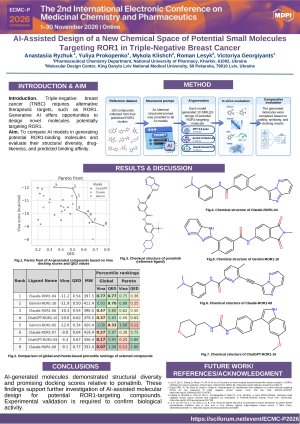
Introduction. Triple-negative breast cancer is characterized by the absence of ER, PR, and HER2 expression, which necessitates the search for alternative molecular targets. One such target is ROR1, specifically its pseudokinase domain.
Objective. Compare generative AI models based on their ability to generate structurally diverse small molecules with ROR1-targeting potential, and conduct a preliminary computational evaluation of these molecules.
Methods. AI models GPT-5.6 Luna, Gemini 3.5 Flash-Lite, and Claude Sonnet 5.5 were given the same structured prompt based on 130 compounds from four ROR1 studies. Each model generated 10 SMILES strings, which were validated by conversion to molecular graphs. Structural diversity was assessed using the Tanimoto coefficient. Docking was performed in AutoDock Vina v1.2.5 against ROR1 (PDB 6TU9), using ponatinib as the reference ligand.
Results. In-group Tanimoto distance was 0.77±0.13 for ChatGPT, 0.68±0.17 for Claude, and 0.68±0.11 for Gemini-generated sets. The mean Tanimoto similarity to the reference set was 0.23±0.12, 0.29±0.10, and 0.30±0.09, respectively. The average docking scores were −10.38±1.04, −10.27±1.07, and −10.66±0.93 kcal/mol, respectively. Gemini-ROR1-05 exhibited the best docking score (−12.03 kcal/mol, versus −12.44 kcal/mol for ponatinib). Claude-generated molecules outperformed ChatGPT, Gemini, and reference sets based on QED (0.51±0.17; range 0.25–0.77) and SA (2.57±0.17) scores.
Conclusions. All models generated valid and structurally diverse molecules. ChatGPT demonstrated the greatest in-group diversity, while Gemini achieved the best average docking score. These metrics did not reveal a clear advantage for any single model. Some compounds had docking performance close to that of ponatinib, which supports their further validation.
Keywords
ROR1
small molecules
generative artificial intelligence
structure–activity relationship
molecular design
triple-negative breast cancer
Poster
Poster_Ryzhuk.pdf
Data-driven identification of potential NDM-1 inhibitors using machine learning and large-scale virtual screening.
Interpretable Machine Learning for Early-Stage Aqueous Solubility Prediction in Drug Discovery Using Molecular Descriptors and Applicability Domain Analysis