Event submissions
EventsThe 2nd International Electronic Conference on Medicinal Chemistry and Pharmaceutics
Published
This submission belongs to the session S5. Novel Methodologies and AI of the event The 2nd International Electronic Conference on Medicinal Chemistry and Pharmaceutics
Published date
28 Oct, 2026
Academic Editor
 Mary J. Meegan
Contribution&Funding
Conceptualization,
[Ratikorn Sornumpol]
Funding: --
Citation
Ratikorn Sornumpol, Kuntapong Lamulponge, Interpretable Machine Learning for Early-Stage Aqueous Solubility Prediction in Drug Discovery Using Molecular Descriptors and Applicability Domain Analysis, in Proceedings of The 2nd International Electronic Conference on Medicinal Chemistry and Pharmaceutics, 1 November–30 November 2026, MDPI: Basel, Switzerland
Share
Email
Facebook
Twitter
LinkedIn
Interpretable Machine Learning for Early-Stage Aqueous Solubility Prediction in Drug Discovery Using Molecular Descriptors and Applicability Domain Analysis

Ratikorn Sornumpol 1
Kuntapong Lamulponge 2
1. Master of Science in Financial Engineering Program, WorldQuant University, Bangkok, 10520, Thailand
2. Science, Assumption College Samutprakarn, Samut Prakan, 10270, Thailand
Abstract
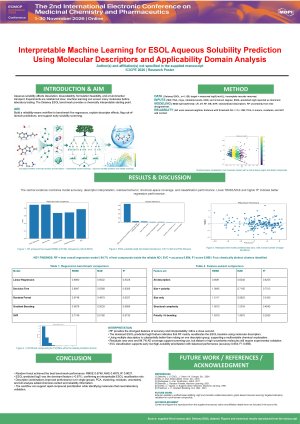
Aqueous solubility is a critical pharmacokinetic parameter that dictates drug formulation, absorption, and oral bioavailability. Because experimental measurement bottlenecks early-stage drug discovery, rapid and reliable computational methodologies are essential for candidate prioritization. This study presents an interpretable artificial intelligence framework for predicting aqueous solubility utilizing the Delaney ESOL dataset (1,128 organic compounds). We engineered models using six fundamental structural descriptors: molecular weight, polar surface area, number of rings, rotatable bonds, hydrogen-bond donors, and minimum degree. Five machine learning algorithms were benchmarked: Linear Regression, Decision Trees, Random Forests, Gradient Boosting, and Support Vector Regression.
Non-linear ensemble methods significantly outperformed traditional linear approaches. Random Forest achieved the highest predictive accuracy (RMSE = 0.6748, MAE = 0.4879, R2 = 0.9037). Crucially, feature importance analysis revealed that baseline ESOL-predicted log solubility acts as the dominant feature, allowing the algorithm to function as an advanced recalibration model alongside insights from polar surface area and molecular weight. To ensure reliability for medicinal chemistry applications, an applicability domain (AD) analysis confirmed that 94.7% of test compounds resided within a trustworthy prediction space.
Furthermore, the framework integrates Principal Component Analysis (PCA) and K-means clustering to map chemical spaces, while a Support Vector Classifier (SVC) achieved 85.4% accuracy for binary solubility categorization. This multifaceted workflow transforms solubility prediction from a "black-box" algorithm into a transparent, practical AI methodology, enabling robust virtual screening and faster prioritization of promising pharmacophores.
Keywords
aqueous solubility; machine learning; drug discovery; cheminformatics; random forest; applicability domain
Poster
ESOL_Interpretable_ML_Poster_EN(1).pdf
AI-Assisted Design of a New Chemical Space of Potential Small Molecules Targeting ROR1 in Triple-Negative Breast Cancer
A Hybrid Computational Framework for Gastroretentive Drug Delivery: Integrating PBPK Modelling and Design of Experiments for Systematic Formulation Optimisation