Event submissions
EventsThe 2nd International Electronic Conference on Medicinal Chemistry and Pharmaceutics
Published
This submission belongs to the session S5. Novel Methodologies and AI of the event The 2nd International Electronic Conference on Medicinal Chemistry and Pharmaceutics
Published date
28 Oct, 2026
Academic Editor
 Thierry Vandamme
Contribution&Funding
Conceptualization,
[VANESSA DANAI BEREJENA] ; [Humphrey Masimba Makumbirofa]
Formal analysis,
[VANESSA DANAI BEREJENA]
Investigation,
[VANESSA DANAI BEREJENA]
Data curation,
[VANESSA DANAI BEREJENA]
Writing - original draft,
[VANESSA DANAI BEREJENA]
Writing - review,
[editing] ; [Humphrey Masimba Makumbirofa]
Supervision,
[Humphrey Masimba Makumbirofa]
Funding: --
Citation
VANESSA DANAI BEREJENA, Humphrey Masimba Makumbirofa, A Hybrid Computational Framework for Gastroretentive Drug Delivery: Integrating PBPK Modelling and Design of Experiments for Systematic Formulation Optimisation, in Proceedings of The 2nd International Electronic Conference on Medicinal Chemistry and Pharmaceutics, 1 November–30 November 2026, MDPI: Basel, Switzerland
Share
Email
Facebook
Twitter
LinkedIn
A Hybrid Computational Framework for Gastroretentive Drug Delivery: Integrating PBPK Modelling and Design of Experiments for Systematic Formulation Optimisation

VANESSA DANAI BEREJENA 1

Humphrey Masimba Makumbirofa 2
1. Dispensary, Trinity Pharmacy, Harare, Zimbabwe
2. Department of Pharmaceutical Technology, The Harare Institute of Technology, Harare, Zimbabwe
Abstract
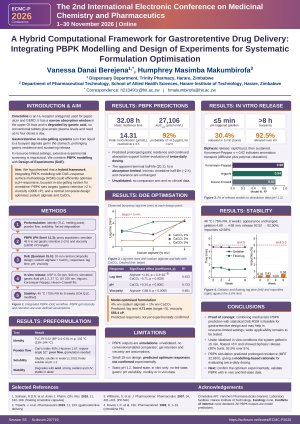
Introduction: In resource‑limited settings, extensive experimental formulation screening is impractical. Cimetidine, an H₂‑receptor antagonist, suffers from low oral bioavailability (30–40%) and a short half‑life, demanding gastroretentive delivery. We hypothesised that a hybrid framework integrating Physiologically Based Pharmacokinetic (PBPK) modelling with Design of Experiments–Response Surface Methodology (DoE‑RSM) could efficiently optimise an in‑situ gelling system, providing a cost‑effective alternative to extensive pharmacokinetic studies.
Methods: PBPK modelling (PK‑Sim® v11.3), using a proxy population with parameter adjustments representative of Sub‑Saharan African physiology, predicted how the pH‑responsive buoyant system modulates cimetidine absorption, including gastric residence time and viscosity targets. A 10‑run Central Composite Design then optimised sodium alginate (2–6% w/v) and calcium carbonate (0.5–1.5% w/v), targeting buoyancy lag time (<5 min), floating duration (>8 h) and pH compatibility. Model performance was assessed via R², F‑statistics and residual diagnostics.
Results: PBPK predicted a mean residence time of 32.08 h and AUC_inf of 27,106 µmol.min/L (comparative validation pending). DoE‑RSM identified sodium alginate as the dominant factor (buoyancy lag coefficient +1.16, p=3.29×10⁻⁵, R²=0.813). The model‑optimised formulation (4% alginate, 1% CaCO₃) predicted a buoyancy lag time of 4.71 min and viscosity of 555.4 cP; experimental confirmation is required. R² ranged from 0.65 to 0.813 (p<0.01).
Conclusions: This proof‑of‑concept computational framework demonstrates the feasibility of combining mechanistic PBPK prediction with statistical DoE‑RSM for gastroretentive formulation development. The PBPK approach, using a proxy African population and parameter adjustments, offers a cost‑effective alternative to extensive PK studies, is valuable in resource‑limited settings, and provides a methodology applicable to other acid‑labile drugs with narrow absorption windows. Key limitations include unvalidated predictions, the limited 10‑run design, and the absence of experimental and in vivo corroboration.
Keywords
PBPK modelling; Design of Experiments; QbD; Response Surface Methodology; gastroretentive; in silico prediction
Poster
Cimetidine PBPK & DoE Hybrid Framework Poster.pdf
Interpretable Machine Learning for Early-Stage Aqueous Solubility Prediction in Drug Discovery Using Molecular Descriptors and Applicability Domain Analysis
Thioglycerol-Substituted Zinc(II) Phthalocyanines as Antibacterial Agents against Staphylococcus aureus and Escherichia coli