Event submissions
EventsThe 2nd International Electronic Conference on Medicinal Chemistry and Pharmaceutics
Published
This submission belongs to the session S6. New Modalities in Drug Discovery of the event The 2nd International Electronic Conference on Medicinal Chemistry and Pharmaceutics
Published date
28 Oct, 2026
Academic Editor
 Maria Emília Sousa
Contribution&Funding
Methodology,
[nadia farah]
Funding: --
Citation
nadia farah, Rabya Munawar, Nosheen Mushtaq, Saima Sarfaraz, Shazia Haider, N-Substituted 9-Aminoacridine Derivatives as Promising Antimicrobial Agents: Synthesis, Characterization, and Structure–Activity Relationship., in Proceedings of The 2nd International Electronic Conference on Medicinal Chemistry and Pharmaceutics, 1 November–30 November 2026, MDPI: Basel, Switzerland
Share
Email
Facebook
Twitter
LinkedIn
N-Substituted 9-Aminoacridine Derivatives as Promising Antimicrobial Agents: Synthesis, Characterization, and Structure–Activity Relationship.

nadia farah 1
Rabya Munawar 2
Nosheen Mushtaq 1
Saima Sarfaraz 3
Shazia Haider 1
1. Department of Pharmaceutical Chemistry, Faculty of Pharmacy and Pharmaceutical Sciences, University of Karachi, karachi, 75950, Pakistan
2. Department of Pharmaceutical Chemistry, Dow College of Pharmacy and Faculty of Pharmaceutical Sciences, DUHS, OJHA, Pakistan
3. Department of Microbiology, Federal Urdu University (FUUAST), GULSHAN CAMPUS , Karachi, Pakistan
Abstract
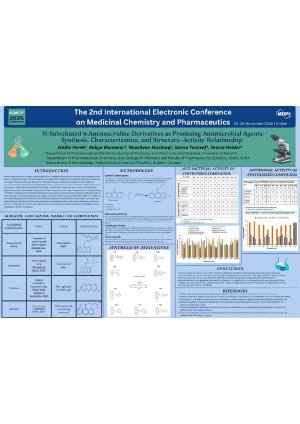
Introduction: The increasing prevalence of antimicrobial resistance necessitates development of novel antimicrobial agents with improved efficacy and broader activity spectra. Acridine derivatives particularly 9-aminoacridine have attracted considerable interest as promising antimicrobial pharmacophore. In this study, we have synthesized ten derivatives and evaluated N-substituted 9-aminoacridine derivatives for antibacterial and antifungal activities
Methods: Ten derivatives were synthesized through N-alkylation and characterized using TLC, M.P., UV, FTIR, ¹H-NMR, and FABMS. Antibacterial activity was evaluated against selected Gram-positive and Gram-negative bacterial strains using the agar diffusion method, with Gentamicin as the reference standard. Antifungal activity was assessed against Aspergillus fumigatus, Rhizopus spp., and Candida albicans, using Fluconazole as the reference standard.
Results: Among the synthesized derivatives, PMA exhibited the most potent antibacterial activity, comparable to or greater than Gentamicin against E-coli, Proteus mirabilis, Enterococcus spp., and Staphylococcus aureus. PPA also demonstrated notable antibacterial activity and showed the highest antifungal activity against Rhizopus spp., slightly exceeding that of Fluconazole, while PBrS exhibited comparable antifungal activity. Structure–activity relationship analysis revealed that structural modifications at the 9-amino position significantly influenced antimicrobial potency and activity spectrum.
Conclusion:. Overall, the synthesized ten derivatives of 9-amino Acridine demonstrated promising antimicrobial potential, identifying PMA and PPA as particularly promising candidates for further optimization and evaluation.
Keywords
9-Aminoacridine
N-substituted derivatives
Antimicrobial activity
Antibacterial activity
Antifungal activity
Structure–activity relationship
Acridine derivatives.
Poster
scientific poster.pdf
From Conformational Control to GPCR Recognition: Structure-Guided Design of Short Peptide and Peptidomimetic Ligands
AAV8-Mediated shRNA Knockdown of PCSK9 as Gene Therapy for Dyslipidemia.