Event submissions
EventsThe 2nd International Electronic Conference on Medicinal Chemistry and Pharmaceutics
Published
This submission belongs to the session S6. New Modalities in Drug Discovery of the event The 2nd International Electronic Conference on Medicinal Chemistry and Pharmaceutics
Published date
28 Oct, 2026
Academic Editor
 Mary J. Meegan
Contribution&Funding
Conceptualization,
[Evgeny E. Bezsonov]
Methodology,
[Evgeny E. Bezsonov]
Software,
[Evgeny E. Bezsonov]
Validation,
[Evgeny E. Bezsonov]
Formal analysis,
[Evgeny E. Bezsonov]
Investigation,
[Evgeny E. Bezsonov]
Resources,
[Evgeny E. Bezsonov]
Data curation,
[Evgeny E. Bezsonov]
Writing - original draft,
[Evgeny E. Bezsonov]
Writing - review,
[editing] ; [Evgeny E. Bezsonov]
Visualization,
[Evgeny E. Bezsonov]
Supervision,
[Evgeny E. Bezsonov]
Project administration,
[Evgeny E. Bezsonov]
Funding acquisition,
[Evgeny E. Bezsonov]
Funding: Russian Science Foundation, grant number 26-25-20099
Citation
Evgeny E. Bezsonov, AAV8-Mediated shRNA Knockdown of PCSK9 as Gene Therapy for Dyslipidemia., in Proceedings of The 2nd International Electronic Conference on Medicinal Chemistry and Pharmaceutics, 1 November–30 November 2026, MDPI: Basel, Switzerland
Share
Email
Facebook
Twitter
LinkedIn
AAV8-Mediated shRNA Knockdown of PCSK9 as Gene Therapy for Dyslipidemia.

Evgeny E. Bezsonov 1
1. Biology and General Genetics, Sechenov First Moscow State Medical University (Sechenov University), Moscow, 105043, Russia
Abstract
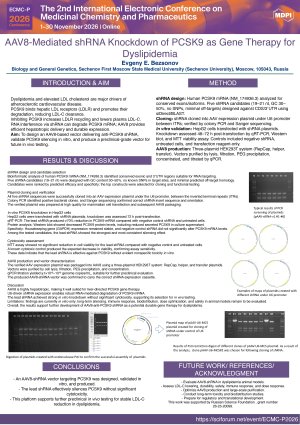
Dyslipidemia and elevated LDL cholesterol are major drivers of atherosclerotic cardiovascular disease. PCSK9 binds hepatic LDL receptors and promotes their degradation; its inhibition increases LDLR recycling and lowers plasma LDL-C. We aimed to develop an AAV8-based gene therapy delivering shRNA for durable PCSK9 silencing. First, human PCSK9 mRNA (NM_174936.3) was analyzed for conserved exons and isoforms. 5 shRNA candidates (19–21 nt, GC 30–50%, no SNPs or predicted off-targets) were designed against CDS/3′UTR. Candidates were cloned into an AAV expression plasmid under U6 promoter between ITRs and verified by colony PCR and Sanger sequencing. Huh7/HepG2 cells were transfected with shRNA plasmids. Knockdown was assessed 48–72 h post-transfection by qRT-PCR, Western blot/ELISA, and MTT. The lead shRNA produced >70% reduction in PCSK9 mRNA and decreased secreted PCSK9 without significant cytotoxicity versus negative controls. The verified plasmid was packaged into AAV8 using a three-plasmid HEK293T system with RepCap, helper, and transfer plasmids; vectors were purified by lysis, filtration, PEG precipitation/affinity chromatography, and concentrated. qPCR titration yielded ≥1×10¹²-13 genome copies/mL. An AAV8-shRNA vector targeting PCSK9 was successfully designed, validated in vitro, and produced. This platform supports further in vivo testing for stable LDL-C reduction in dyslipidemia.
Keywords
PCSK9
shRNA
AAV8
Dyslipidemia
Gene therapy
Poster
Sciforum-211519 poster 2026.pdf
N-Substituted 9-Aminoacridine Derivatives as Promising Antimicrobial Agents: Synthesis, Characterization, and Structure–Activity Relationship.
EFFECTS OF ORALLY ADMINISTERED ENGINEERED E. COLI EXPRESSING M-GLP-1 ON BODY WEIGHT IN A RAT MODEL OF TYPE 2 DIABETES