Event submissions
EventsThe 2nd International Electronic Conference on Medicinal Chemistry and Pharmaceutics
Published
This submission belongs to the session S6. New Modalities in Drug Discovery of the event The 2nd International Electronic Conference on Medicinal Chemistry and Pharmaceutics
Published date
28 Oct, 2026
Academic Editor
 Maria Emília Sousa
Contribution&Funding
Conceptualization,
[Vagif A. Gasanov]
Methodology,
[Dmitry A. Kashirskikh]
Formal analysis,
[Arthur A. Lee] ; [Dmitry A. Kashirskikh]
Investigation,
[Olesya O. Klychkova] ; [Arthur A. Lee] ; [Dmitry A. Kashirskikh]
Resources,
[Vagif A. Gasanov]
Data curation,
[Olesya O. Klychkova] ; [Victoria A. Khotina]
Writing - original draft,
[Arthur A. Lee]
Writing - review,
[editing] ; [Victoria A. Khotina]
Visualization,
[Victoria A. Khotina]
Supervision,
[Vagif A. Gasanov]
Project administration,
[Vagif A. Gasanov]
Funding acquisition,
[Vagif A. Gasanov]
Funding: The Ministry of Science and Higher Education of the Russian Federation in 2026 (No. 0088-2025-0002).
Citation
Olesya O. Klychkova, Arthur A. Lee, Victoria A. Khotina, Dmitry A. Kashirskikh, Vagif A. Gasanov, EFFECTS OF ORALLY ADMINISTERED ENGINEERED E. COLI EXPRESSING M-GLP-1 ON BODY WEIGHT IN A RAT MODEL OF TYPE 2 DIABETES, in Proceedings of The 2nd International Electronic Conference on Medicinal Chemistry and Pharmaceutics, 1 November–30 November 2026, MDPI: Basel, Switzerland
Share
Email
Facebook
Twitter
LinkedIn
EFFECTS OF ORALLY ADMINISTERED ENGINEERED E. COLI EXPRESSING M-GLP-1 ON BODY WEIGHT IN A RAT MODEL OF TYPE 2 DIABETES

Olesya O. Klychkova 1
Arthur A. Lee 1

Victoria A. Khotina 1
Dmitry A. Kashirskikh 1
Vagif A. Gasanov 1
1. Core Centrum «Genomic Technologies Group», Koltzov Institute of Developmental Biology of the Russian Academy of Sciences (IDB RAS), Moscow, 119334, Russia
Abstract
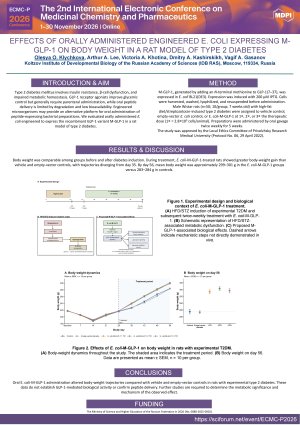
Introduction: Type 2 diabetes mellitus involves insulin resistance, β-cell dysfunction, and impaired metabolic homeostasis. GLP-1 receptor agonists improve glycemic control but generally require parenteral administration, while oral peptide delivery is limited by degradation and low bioavailability. Engineered microorganisms may provide an alternative platform for oral administration of peptide-expressing bacterial preparations. We evaluated orally administered E. coli engineered to express the recombinant GLP-1 variant M-GLP-1 in a rat model of type 2 diabetes.
Methods: M-GLP-1, generated by adding an N-terminal methionine to GLP-1(7–37), was expressed in E. coli BL21(DE3). Expression was induced with 200 µM IPTG. Cells were harvested, washed, lyophilized, and resuspended before administration. Male Wistar rats (n=50; 10/group; 7 weeks old) with high-fat diet/streptozotocin-induced type 2 diabetes were assigned to vehicle control, empty-vector E. coli control, or E. coli-M-GLP-1 at 1×, 2×, or 3× the therapeutic dose (1× = 2.8×10⁵ cells/animal). Preparations were administered by oral gavage twice weekly for 5 weeks. The study was approved by the Local Ethics Committee of Privolzhsky Research Medical University (Protocol No. 06, 29 April 2022).
Results: Body weight was comparable among groups before and after diabetes induction. During treatment, E. coli-M-GLP-1-treated rats showed greater body-weight gain than vehicle and empty-vector controls, with trajectories diverging from day 35. By day 56, mean body weight was approximately 299–301 g in the E. coli-M-GLP-1 groups versus 283–284 g in controls.
Conclusions: Oral E. coli-M-GLP-1 administration altered body-weight trajectories compared with vehicle and empty-vector controls in rats with experimental type 2 diabetes. These data do not establish GLP-1-mediated biological activity or confirm peptide delivery. Further studies are required to determine the metabolic significance and mechanism of the observed effect.
Keywords
engineered Escherichia coli
GLP-1
oral delivery
type 2 diabetes mellitus
recombinant peptide
Wistar rats
Poster
2.pdf
AAV8-Mediated shRNA Knockdown of PCSK9 as Gene Therapy for Dyslipidemia.
FDA-approved drugs as probes for mixMD: a pipeline modeled on the identification of cryptic pockets of SARS-CоV-2 3CLpro