Event submissions
EventsThe 2nd International Electronic Conference on Medicinal Chemistry and Pharmaceutics
Published
This submission belongs to the session S8. Nanomedicine and Nanotechnology of the event The 2nd International Electronic Conference on Medicinal Chemistry and Pharmaceutics
Published date
28 Oct, 2026
Academic Editor
 Francisco Javier Otero Espinar
Contribution&Funding
Conceptualization,
[Anton Kiselev] ; [Anna Egorova ]
Methodology,
[Anton Kiselev]
Formal analysis,
[Anton Kiselev] ; [Anna Egorova ]
Investigation,
[Iuliia Krylova] ; [Sofia Shtykalova] ; [Anna Egorova ] ; [Svetlana Freund]
Resources,
[Anton Kiselev]
Writing - original draft,
[Anton Kiselev] ; [Anna Egorova ]
Writing - review,
[editing] ; [Anton Kiselev]
Visualization,
[Iuliia Krylova]
Supervision,
[Anton Kiselev]
Project administration,
[Anton Kiselev]
Funding acquisition,
[Anton Kiselev]
Funding: This study was funded by Russian Science Foundation; grant # 24-15-00498
Citation
Anna Egorova , Svetlana Freund, Sofia Shtykalova, Marianna Maretina, Anton Kiselev, Iuliia Krylova, Electrostatically stabilized anti-VEGFA siRNA—peptide polyplexes for anti-angiogenic therapy of endometriosis, in Proceedings of The 2nd International Electronic Conference on Medicinal Chemistry and Pharmaceutics, 1 November–30 November 2026, MDPI: Basel, Switzerland
Share
Email
Facebook
Twitter
LinkedIn
Electrostatically stabilized anti-VEGFA siRNA—peptide polyplexes for anti-angiogenic therapy of endometriosis

Anna Egorova 1
Svetlana Freund 1
Sofia Shtykalova 1
Marianna Maretina 1

Anton Kiselev 1
Iuliia Krylova 2
1. Department of Genomic Medicine named after V.S. Baranov, D.O. Ott Research Institute of Obstetrics, Gynecology and Reproductology, Saint-Petersburg, 199034, Russia
2. Department of Pathology, Pavlov First Saint-Petersburg State Medical University, Saint-Petersburg, Russia
Abstract
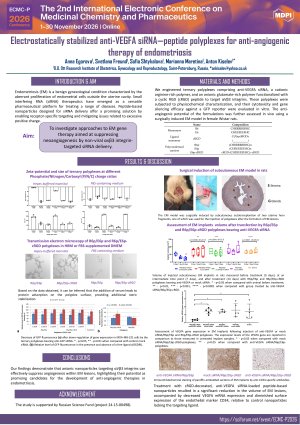
Endometriosis (EM) is a benign gynecological condition characterized by the aberrant proliferation of endometrial cells outside the uterine cavity. This pathological cell growth, accompanied by neoangiogenesis, contributes to the formation of EM lesions. Current pharmacological interventions for EM are often associated with adverse side effects, underscoring the necessity for alternative therapeutic strategies to improve disease management. Small interfering RNA (siRNA) therapeutics have emerged as a versatile pharmaceutical platform for treating a range of diseases; however, their clinical application is limited primarily by challenges related to effective delivery. Peptide-based nanoparticles designed for siRNA delivery offer a promising solution by enabling receptor-specific targeting and mitigating issues related to excessive positive charge. In this study, we engineered ternary polyplexes comprising anti-VEGFA siRNA, a cationic arginine-rich polymer, and an anionic glutamate-rich polymer functionalized with a cyclic RGD (cRGD) peptide to target αVβ3 integrins. These polyplexes were subjected to physicochemical characterization, and their cytotoxicity and gene silencing efficacy against a GFP reporter were evaluated in vitro. The anti-angiogenic potential of the formulations was further assessed in vivo using a surgically induced EM model in female Wistar rats. Treatment with cRGD-decorated, anti-VEGFA siRNA-loaded peptide-based nanoparticles resulted in a significant reduction in the volume of EM lesions, accompanied by decreased VEGFA mRNA expression and diminished surface expression of the endothelial marker CD34, relative to control nanoparticles lacking the targeting ligand. Collectively, these findings demonstrate that anionic nanoparticles targeting αVβ3 integrins can effectively suppress angiogenesis within EM lesions, highlighting their potential as promising candidates for the development of anti-angiogenic therapies in endometriosis.
Keywords
endometriosis
anti-angiogenic therapy
siRNA delivery
peptide-based carriers
gene therapy
VEGFA
ternary polyplexes
Poster
poster ECMC Egorova.pdf
Apis mellifera Royal Jelly-derived Extracellular Vesicles (RJ-EVs) as Novel Anti-inflammatory Nanotherapeutics for Equine Metabolic Syndrome-Affected Adipose Stem Cells
Green Nanotechnology with Curcuma zedoaria: Phytochemical Characterization and In-vitro Antioxidant Activity of Biosynthesized Zinc Oxide Nanoparticles