Event submissions
EventsThe 2nd International Electronic Conference on Medicinal Chemistry and Pharmaceutics
Published
This submission belongs to the session S8. Nanomedicine and Nanotechnology of the event The 2nd International Electronic Conference on Medicinal Chemistry and Pharmaceutics
Published date
28 Oct, 2026
Academic Editor
 Thierry Vandamme
Contribution&Funding
Conceptualization,
[Chinemerem Chidimma Dabrinze] ; [Ifeoma Chukwuma]
Methodology,
[Chinemerem Chidimma Dabrinze]
Software,
[Chinemerem Chidimma Dabrinze]
Validation,
[Ifeoma Chukwuma]
Formal analysis,
[Ifeoma Chukwuma]
Investigation,
[Nene Hephzibah Chiaka-Onyemeze]
Resources,
[Chinemerem Chidimma Dabrinze]
Data curation,
[Chinemerem Chidimma Dabrinze]
Writing - original draft,
[Chinemerem Chidimma Dabrinze]
Writing - review,
[editing] ; [Lawrence Ezeanyika]
Visualization,
[Lawrence Ezeanyika] ; [Glory Ezinne Okereke]
Supervision,
[Nene Hephzibah Chiaka-Onyemeze] ; [Lawrence Ezeanyika]
Project administration,
[Lawrence Ezeanyika]
Funding: none
Citation
Chinemerem Chidimma Dabrinze, Nene Hephzibah Chiaka-Onyemeze, Ifeoma Chukwuma, Lawrence Ezeanyika, Glory Ezinne Okereke, Green Nanotechnology with Curcuma zedoaria: Phytochemical Characterization and In-vitro Antioxidant Activity of Biosynthesized Zinc Oxide Nanoparticles, in Proceedings of The 2nd International Electronic Conference on Medicinal Chemistry and Pharmaceutics, 1 November–30 November 2026, MDPI: Basel, Switzerland
Share
Email
Facebook
Twitter
LinkedIn
Green Nanotechnology with Curcuma zedoaria: Phytochemical Characterization and In-vitro Antioxidant Activity of Biosynthesized Zinc Oxide Nanoparticles

Chinemerem Chidimma Dabrinze 1
Nene Hephzibah Chiaka-Onyemeze 1
Ifeoma Chukwuma 1
Lawrence Ezeanyika 1
Glory Ezinne Okereke 1
1. Biochemistry, University of Nigeria Nsukka, Nsukka, 461109, Nigeria
Abstract
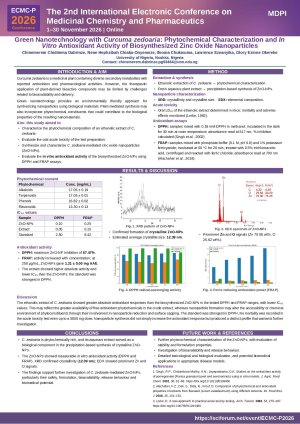
Curcuma zedoaria is a medicinal plant rich in secondary metabolites with reported antioxidant and pharmacological properties. However, the potential biomedical application of plant-derived bioactive compounds may be constrained by challenges associated with their delivery and bioavailability. Plant-mediated nanoparticle synthesis offers an approach for developing nanomaterials that warrant further investigation as potential delivery platforms for bioactive constituents. This study evaluated the phytochemical composition of an ethanolic extract of C. zedoaria, the acute toxicity of the test preparation, and the physicochemical characteristics and in vitro antioxidant activity of C. zedoaria-mediated zinc oxide nanoparticles (ZnO-NPs). Preliminary quantitative phytochemical screening was performed on the extract, while ZnO-NPs were prepared using the green synthesis precipitation-based method involving the freshly prepared aqueous plant extract. Acute toxicity was evaluated in experimental animals following oral administration. Nanoparticle crystallinity and elemental composition were assessed using X-ray diffraction (XRD) and energy-dispersive X-ray (EDX) spectroscopy, respectively. Antioxidant activity was investigated using the 1,1-diphenyl-2-picrylhydrazyl (DPPH) radical-scavenging and ferric reducing antioxidant power (FRAP) assays. The extract contained several phytochemical groups, with alkaloids and terpenoids among the most abundant constituents (17.05 ± 0.19 and 17.05 ± 0.01 mg/mL, respectively), followed by phenols (16.82 ± 0.02 mg/mL) and flavonoids (13.30 ± 0.13 mg/mL). No mortality or observable adverse reactions were recorded up to 5000 mg/kg body weight under the conditions of the oral acute toxicity assessment. XRD analysis confirmed crystalline ZnO-NPs, with an estimated average crystallite size of 12.39 nm, while EDX revealed prominent zinc and oxygen signals. The ZnO-NPs exhibited concentration-dependent DPPH radical-scavenging activity, reaching 67.47% inhibition, with a reported IC₅₀ of 0.10 µg/mL. FRAP activity also increased with concentration, reaching 1.21 ± 0.00 mg ascorbic acid equivalents (AAE) at 250 µg/mL. These findings demonstrate the phytochemical richness of C. zedoaria and the potential of its extract as a biological component in the preparation of crystalline ZnO-NPs with measurable in-vitro antioxidant activity. The findings provide a basis for further investigation of their safety, formulation characteristics, bioavailability, and release behaviour before determining their suitability for specific biomedical applications.
Keywords
Curcuma zedoaria; zinc oxide nanoparticles; green synthesis; phytochemicals; DPPH; FRAP; antioxidant activity.
Poster
Dabrinze Chinemerem Poster.pdf
Electrostatically stabilized anti-VEGFA siRNA—peptide polyplexes for anti-angiogenic therapy of endometriosis
Asymmetric liposomes prepared with a simple cyclodextrin-lipid complex method to improve performance of vesicles beyond conventional liposomes