Event submissions
EventsThe 2nd International Electronic Conference on Medicinal Chemistry and Pharmaceutics
Published
This submission belongs to the session S8. Nanomedicine and Nanotechnology of the event The 2nd International Electronic Conference on Medicinal Chemistry and Pharmaceutics
Published date
28 Oct, 2026
Academic Editor
 Francisco Javier Otero Espinar
Citation
Sarah BOUAMEUR, Amina SARDI, Farida BOUANANI, Fatma Zohra GHANASSI, The role of Surface Tension Measurement in Lipid Nanoparticle Formulation, in Proceedings of The 2nd International Electronic Conference on Medicinal Chemistry and Pharmaceutics, 1 November–30 November 2026, MDPI: Basel, Switzerland
Share
Email
Facebook
Twitter
LinkedIn
The role of Surface Tension Measurement in Lipid Nanoparticle Formulation

Sarah BOUAMEUR 1,2
Amina SARDI 3
Farida BOUANANI 4
Fatma Zohra GHANASSI 5,6
1. Pharmacy, University of Oran 1, oran, 31000, Algeria
2. Pharmacy, University Djillali Liabes, Sidi Bel abbes, 22000, Algeria
3. Laboratory of Macromolecular Physical Chemistry LCPM, University of Oran 1, oran, 31000, Algeria
4. Laboratory of Environmental Technology Research (LTE), University of Oran 1, oran, 31000, Algeria
5. Pharmacy, University of Medical Sciences , Algiers, 16000, Algeria
6. Laboratory of Galenic and Industrial Pharmacy LRPGI, University of Algiers 1, Algiers, 16000, Algeria
Abstract
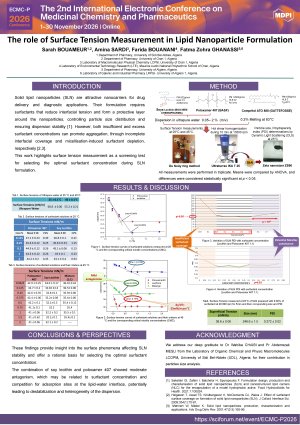
Solid lipid nanoparticles (SLN) are attractive nanocarriers for drug delivery and diagnostic applications. Their formulation requires surfactants that reduce interfacial tension and form a protective layer around the nanoparticles, controlling particle size distribution and ensuring dispersion stability. However, both insufficient and excess surfactant concentrations can promote aggregation, through incomplete interfacial coverage and micellisation-induced surfactant depletion, respectively. This work highlights surface tension measurement as a screening test for selecting the optimal surfactant concentration during SLN formulation.
SLN were prepared by hot melt emulsification method with 1% Compritol ATO888 as the lipidic matrix. Poloxamer 407 and soy lecithin were used as surfactants, either individually or in 1:1 ratio. The surfactant concentrations were ranged from 0.02 to 2% (m/v). Particle size (PS) and polydispersity index (PDI) were assessed by Dynamic Light Scattering (DLS) at 25°C.
The surface tensions of SLN dispersions and those of aqueous surfactant solutions were investigated with Du Noüy ring method at 25°C and 45 °C. Critical micelle concentrations (CMC) were determined graphically.
Surface tension measurements indicated distinct thermal behavior among the surfactants, with lecithin exhibiting greater temperature sensitivity at 45°C, decreasing by 0.55 mN/m per °C. The CMC determination for the individual surfactant solutions and their 1:1 mixture revealed a mild antagonism, which may limit surface adsorption at the particle interface. Consistent with this, SLNs prepared with a 0.02% surfactant mixture exhibited a particle size of 246±1.5 nm and higher surface tension than the corresponding surfactant mixture solutions. Furthermore, the evolution of SLN PS and PDI as a function of surfactant mixture concentration remained stable at concentrations between 0.15–0.5%, and increased significantly above 0.5%, suggesting the potential presence of micelles.
These findings provide insight into the surface phenomena affecting SLN stability and offer a rational basis for selecting the optimal surfactant concentration.
Keywords
micelle
nanoparticle
preformulation
surfactant
tensiometer
Poster
Poster Bouameur.pdf
Green-Synthesized Ag, ZnO, and CuO Nanoparticles: From Formation and Characterization to Biomedical Potential
Design and Evaluation of Granzyme-B Loaded Albumin Nanoparticles for Cancer Immunotherapy