Event submissions
EventsThe 2nd International Electronic Conference on Medicinal Chemistry and Pharmaceutics
Published
This submission belongs to the session S8. Nanomedicine and Nanotechnology of the event The 2nd International Electronic Conference on Medicinal Chemistry and Pharmaceutics
Published date
28 Oct, 2026
Academic Editor
 Thierry Vandamme
Citation
Rohit Gangawat, Nanomedicine: Emerging Technologies for Advanced Healthcare, in Proceedings of The 2nd International Electronic Conference on Medicinal Chemistry and Pharmaceutics, 1 November–30 November 2026, MDPI: Basel, Switzerland
Share
Email
Facebook
Twitter
LinkedIn
Nanomedicine: Emerging Technologies for Advanced Healthcare

Rohit Gangawat 1
1. Department of Zoology, University of Rajasthan, Jaipur, 302004, India
Abstract
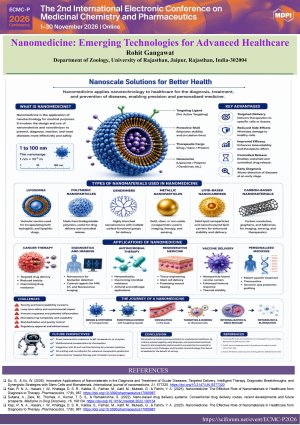
Innovative methods for the molecular and cellular diagnosis, treatment, and prevention of diseases have made nanotechnology a game-changer in contemporary medicine. Utilizing manufactured nanoscale materials as nanomedicine/nanodrug improves patient outcomes and treatment efficacy. Drugs, genes, proteins, and other therapeutic agents can be delivered to particular tissues or cells using nanoparticles such as liposomes, polymeric nanoparticles, dendrimers, metallic nanoparticles, and lipid-based nanocarriers. This focused strategy can improve medication stability and solubility, boost bioavailability, lessen systemic toxicity, and allow for controlled or prolonged drug release. Furthermore, by creating extremely sensitive biosensors, imaging agents, and nanoscale diagnostic platforms that can identify illnesses early on, nanotechnology has made a substantial contribution to diagnostic applications. Additionally, nanomaterials are being investigated for use in vaccine delivery, regenerative medicine, cancer therapy, antimicrobial treatment, and customized healthcare. Notwithstanding these encouraging developments, issues like the toxicity of nanoparticles, biodegradability, immunological reactions, industrial scalability, legal constraints, and long-term environmental effects continue to be significant factors. For nanomedicine to be safe, effective, and clinically applicable, multidisciplinary research must continue. All things considered, the fusion of biomedical research with nanotechnology offers a potential route toward more accurate, effective, and customized treatment. Future advancements in stimuli-responsive delivery systems, smart nanocarriers, and multifunctional nanoparticles may increase the promise of nanomedicine and lead to better treatment outcomes and disease management.
Keywords
Nanotechnology
Nanomedicine
Nanomaterials
Nanodrug
Poster
poster.pdf
Design and Evaluation of Granzyme-B Loaded Albumin Nanoparticles for Cancer Immunotherapy
Adsorption of paclitaxel onto magnetic nanoparticles for potential application in the treatment of triple-negative breast cancer.