Event submissions
EventsThe 2nd International Electronic Conference on Medicinal Chemistry and Pharmaceutics
Published
This submission belongs to the session S8. Nanomedicine and Nanotechnology of the event The 2nd International Electronic Conference on Medicinal Chemistry and Pharmaceutics
Published date
28 Oct, 2026
Academic Editor
 Francisco Javier Otero Espinar
Contribution&Funding
Conceptualization,
[Alicia M. Díaz-García] ; [Yu Cai]
Methodology,
[Glenda Bauta Castañeda] ; [Alicia M. Díaz-García] ; [Lissette Agüero Luztonó] ; [Carmen Soto Febles]
Software,
[Dahysmer Hernández Ricardo] ; [Alicia M. Díaz-García] ; [Glenda Bauta Castañeda] ; [Marcos Muñoz-Arias]
Validation,
[Alicia M. Díaz-García] ; [Glenda Bauta Castañeda]
Formal analysis,
[Dahysmer Hernández Ricardo] ; [Alicia M. Díaz-García] ; [Carmen Soto Febles] ; [Marcos Muñoz-Arias] ; [Glenda Bauta Castañeda]
Investigation,
[Marcos Muñoz-Arias] ; [Alicia M. Díaz-García] ; [Dahysmer Hernández Ricardo] ; [Glenda Bauta Castañeda] ; [Lissette Agüero Luztonó] ; [Carmen Soto Febles]
Resources,
[Alicia M. Díaz-García] ; [Glenda Bauta Castañeda] ; [Marcos Muñoz-Arias]
Data curation,
[Glenda Bauta Castañeda] ; [Alicia M. Díaz-García] ; [Dahysmer Hernández Ricardo] ; [Marcos Muñoz-Arias]
Writing - original draft,
[Dahysmer Hernández Ricardo] ; [Glenda Bauta Castañeda] ; [Alicia M. Díaz-García]
Writing - review,
[editing] ; [Glenda Bauta Castañeda] ; [Alicia M. Díaz-García]
Visualization,
[Yu Cai] ; [Alicia M. Díaz-García]
Supervision,
[Glenda Bauta Castañeda] ; [Alicia M. Díaz-García]
Project administration,
[Alicia M. Díaz-García]
Funding acquisition,
[Marcos Muñoz-Arias] ; [Alicia M. Díaz-García]
Funding: --
Citation
Dahysmer Hernández Ricardo, Glenda Bauta Castañeda, Marcos Muñoz-Arias, Carmen Soto Febles, Lissette Agüero Luztonó, Yu Cai, Alicia M. Díaz-García, Adsorption of paclitaxel onto magnetic nanoparticles for potential application in the treatment of triple-negative breast cancer., in Proceedings of The 2nd International Electronic Conference on Medicinal Chemistry and Pharmaceutics, 1 November–30 November 2026, MDPI: Basel, Switzerland
Share
Email
Facebook
Twitter
LinkedIn
Adsorption of paclitaxel onto magnetic nanoparticles for potential application in the treatment of triple-negative breast cancer.

Dahysmer Hernández Ricardo 1
Glenda Bauta Castañeda 1
Marcos Muñoz-Arias 1,2
Carmen Soto Febles 3
Lissette Agüero Luztonó 4
Yu Cai 5
Alicia M. Díaz-García 1,2
1. Bioinorganic Laboratory, Faculty of Chemistry, University of Havana, Havana City, 10400, Cuba
2. Department of Organic and Inorganic Chemistry, University of the Basque Country (UPV/EHU), Spain
3. Faculty of Biology, University oh Havana, Havana City, 10400, Cuba
4. Biomaterials Center, Faculty of Chemistry, University of Havana, Havana City, 10400, Cuba
5. School of Pharmacy, Jinan University, Guangzhou, China
Abstract
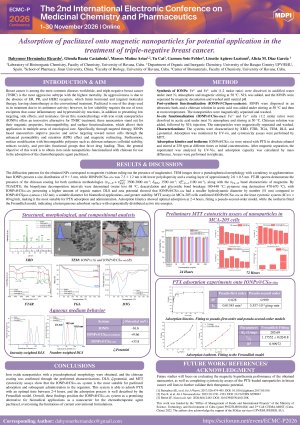
The chemotherapeutic agent paclitaxel is used in the treatment of triple-negative breast cancer. However, its formulation (Taxol®) exhibits high toxicity and poor targeting. A novel solution involves nanostructured systems based on magnetic iron oxide nanoparticles (IONPs) combined with chemotherapeutic agents. These systems show increased targeting and inhibitory action toward cancer cells, proving to be favorable for developing formulations with anticancer activity. For this reason, in this work, a system based on paclitaxel adsorbed onto chitosan-coated iron oxide nanoparticles was obtained for the treatment of triple-negative breast cancer. IONPs were synthesized via the Massart coprecipitation method and functionalized with chitosan using in-situ and post-synthesis methods. They were characterized by XRD, FTIR, TEM, SEM, TGA, DLS, and ζ-Potential. The cell viability of the different systems was studied at various time intervals. The obtained nanoparticles exhibited a diffraction pattern corresponding to magnetite. The presence of chitosan was corroborated by infrared spectroscopy. It was determined that the system obtained via the in-situ method was the most appropriate for paclitaxel immobilization and subsequent administration, according to DLS, ζ-Potential, and cell viability profiles. The adsorption kinetics of paclitaxel were studied. The optimal adsorption time was found to be between 2 and 4 hours. The kinetic data fitted the pseudo-second-order model. The drug adsorption isotherm fitted the Freundlich model, evidencing a heterogeneous adsorbent surface with exponentially distributed active site energies.
Keywords
triple-negative breast cancer; adsorption; paclitaxel; chitosan; iron oxide nanoparticles
Poster
Poster_SciForum_Dahysmer_Hernandez.pdf
Nanomedicine: Emerging Technologies for Advanced Healthcare
Development of a specific magnetic support for tetanus toxoid separation