Event submissions
EventsThe 2nd International Electronic Conference on Medicinal Chemistry and Pharmaceutics
Published
This submission belongs to the session S8. Nanomedicine and Nanotechnology of the event The 2nd International Electronic Conference on Medicinal Chemistry and Pharmaceutics
Published date
28 Oct, 2026
Academic Editor
 Francisco Javier Otero Espinar
Contribution&Funding
Conceptualization,
[Marcos Muñoz Arias]
Methodology,
[Daniel Díaz Casas ] ; [Marcos Muñoz Arias] ; [Glenda Bauta Castañeda ]
Validation,
[Jean Pierre Soubal]
Formal analysis,
[Glenda Bauta Castañeda ] ; [Marcos Muñoz Arias]
Investigation,
[Glenda Bauta Castañeda ] ; [Daniel Díaz Casas ] ; [Marcos Muñoz Arias]
Resources,
[Alicia M. Díaz-García]
Data curation,
[Glenda Bauta Castañeda ]
Writing - original draft,
[Glenda Bauta Castañeda ]
Writing - review,
[editing] ; [Glenda Bauta Castañeda ]
Visualization,
[Marcos Muñoz Arias] ; [Jean Pierre Soubal] ; [Darielys Santana] ; [Alicia M. Díaz-García]
Supervision,
[Alicia M. Díaz-García] ; [Marcos Muñoz Arias] ; [Daniel Díaz Casas ]
Project administration,
[Darielys Santana] ; [Alicia M. Díaz-García]
Funding: --
Citation
Glenda Bauta Castañeda , Marcos Muñoz Arias, Daniel Díaz Casas , Jean Pierre Soubal, Darielys Santana, Alicia M. Díaz-García, Development of a specific magnetic support for tetanus toxoid separation , in Proceedings of The 2nd International Electronic Conference on Medicinal Chemistry and Pharmaceutics, 1 November–30 November 2026, MDPI: Basel, Switzerland
Share
Email
Facebook
Twitter
LinkedIn
Development of a specific magnetic support for tetanus toxoid separation

Glenda Bauta Castañeda 1
Marcos Muñoz Arias 1,2
Daniel Díaz Casas 3
Jean Pierre Soubal 3
Darielys Santana 3
Alicia M. Díaz-García 4
1. Bioinorganic laboratory, Faculty of Chemistry, University of Havana, Havana, Cuba
2. Inorganic and Organic Department, University of the Basque Country, University of the Basque Country, Spain
3. Glicoconjugation Laboratory, Finlay Institute of Vaccines, Havana, Cuba
4. Bioinorganic Laboratory, Faculty of Chemistry, University of Havana, Havana, Cuba
Abstract
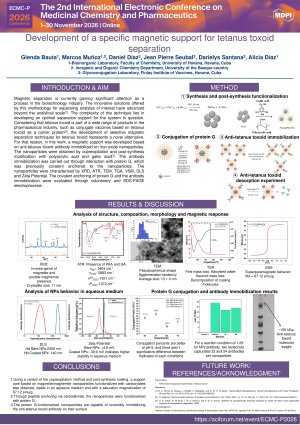
Magnetic separation is currently gaining significant attention as a process in the biotechnology industry. The innovative solutions offered by this methodology for separating analytes of interest have advanced beyond the analytical scale. The complexity of this technique lies in developing an optimal separation support for the system in question. Considering that tetanus toxoid is part of a wide range of products in the pharmaceutical industry, such as conjugate vaccines based on tetanus toxoid as a carrier protein, the development of selective magnetic separation techniques for tetanus toxoid represents a novel alternative. For this reason, in this work, a magnetic support was developed based on anti-tetanus toxoid antibody immobilized on iron oxide nanoparticles. The nanoparticles were obtained by coprecipitation and post-synthesis modification with polyacrylic acid and gallic acid. The antibody immobilization was carried out through interaction with protein G, which was previously anchored to the nanoparticles. The nanoparticles were characterized by X-ray Diffraction, Infrared Spectroscopy, Transmission Electron Microscopy, Scanning Electron Microscopy, Thermogravimetry, Vibrating Sample Magnetometry, Dynamic Light Scattering, and Zeta Potential. The obtained nanoparticles showed a diffraction pattern corresponding to magnetite, a morphology of aggregated spheres with a particle size of 13 nm, and stability in aqueous suspension. The covalent anchoring of protein G was evaluated through colorimetry and SDS-PAGE Electrophoresis. The functionalized nanoparticles with protein G were able to immobilize tetanus toxoid antibody through interaction in an aqueous medium.
Keywords
magnetic separation
specific interactions
anti-tetanus toxoid
conjugation
protein G
iron oxide nanoparticles
Poster
Sciforum2026 poster_Glenda Bauta.pdf
Adsorption of paclitaxel onto magnetic nanoparticles for potential application in the treatment of triple-negative breast cancer.
Effects of Nano-Quercetin on Cypermethrin Induced Liver Injury in Rabbits