Event submissions
EventsThe 2nd International Electronic Conference on Medicinal Chemistry and Pharmaceutics
Published
This submission belongs to the session S8. Nanomedicine and Nanotechnology of the event The 2nd International Electronic Conference on Medicinal Chemistry and Pharmaceutics
Published date
28 Oct, 2026
Academic Editor
 Thierry Vandamme
Citation
Maham Ashraf, Effects of Nano-Quercetin on Cypermethrin Induced Liver Injury in Rabbits, in Proceedings of The 2nd International Electronic Conference on Medicinal Chemistry and Pharmaceutics, 1 November–30 November 2026, MDPI: Basel, Switzerland
Share
Email
Facebook
Twitter
LinkedIn
Effects of Nano-Quercetin on Cypermethrin Induced Liver Injury in Rabbits

Maham Ashraf 1
1. Department of Pharmacy, Faculty of Pharmaceutical Sciences, The University of Faisalabad, Faisalabad, Punjab, 38000, Pakistan
Abstract
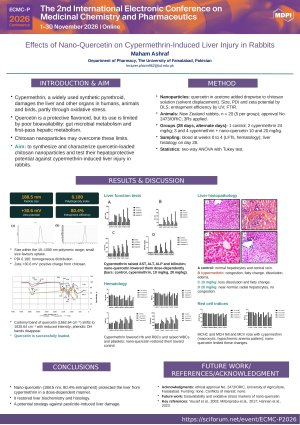
Cypermethrin is a synthetic pyrethroid reported to cause hepatic toxicity and other fatalities in humans as well as animals/birds. Quercetin is a flavonoid that has beneficial health-protective effects, but its use is limited because of its poor bioavailability, metabolism through colonic microbial flora, and first-pass hepatic metabolism. To overcome these limitations, quercetin was loaded into chitosan nanoparticles by following the solvent evaporation method. The study objectives were synthesizing, characterizing quercetin-loaded chitosan nanoparticles, and determining their hepatoprotective potential against chemical (pyrethroid)-induced liver injury in an animal model. The nanoparticles were characterized by zeta size and potential, polydispersity index (PDI), entrapment efficiency, and FTIR. The prepared nano-formulation was physically stable and fell within the nanoscale range (188.5 nm) with high entrapment efficiency (80.4%). The rabbit model was selected because its hepatic metabolic pathways and lipid profile closely resemble those of humans, and no validated in vitro or computational model exists that can adequately replicate the systemic, dose-dependent hepatotoxic response of cypermethrin required to evaluate the nanoformulation's protective efficacy in vivo. In accordance with the 3Rs principles, the sample size (n = 5/group) was statistically determined as the minimum required to achieve reliable and reproducible results, thereby minimizing animal use (Reduction), while animals were housed under standardized conditions with regular monitoring and humane endpoints to minimize distress (Refinement); Ethical approval was taken from ethical committee of University of Agriculture, Faisalabad vide approval No. 2473/ORIC. The study was conducted with four treatment groups (n = 5) comprising 20 rabbits: group 1 was the negative control (normal diet), group 2 was the positive control (cypermethrin 24 mg/kg), and groups 3 and 4 were treated with low-dose (10 mg/kg) and high-dose (20 mg/kg) quercetin-loaded chitosan nanoparticles, respectively, along with cypermethrin (24 mg/kg) for 28 days. Cypermethrin-treated animals showed elevated liver function test (LFT) levels and histopathological lesions in the liver. Co-administration of quercetin-loaded chitosan nanoparticles with cypermethrin successfully ameliorated hepatotoxicity in a dose-dependent manner.
Keywords
chemical induced injury
flavonoids
liver
nanoparticles
Poster
ECMC-P2026_Nano-Quercetin_Poster.pdf
Development of a specific magnetic support for tetanus toxoid separation
Polyphenol Extracts from Glycyrrhiza glabra L.: Encapsulation, Chemical Characterization, and Evaluation of Anti-Inflammatory, Anti-Proliferative, Oral, and Intraperitoneal Activities