Event submissions
EventsThe 2nd International Electronic Conference on Medicinal Chemistry and Pharmaceutics
Published
This submission belongs to the session S9. Formulation, Drug Delivery, and Controlled Release of the event The 2nd International Electronic Conference on Medicinal Chemistry and Pharmaceutics
Published date
28 Oct, 2026
Academic Editor
 Francisco Javier Otero Espinar
Contribution&Funding
Funding: This research was financed by the Medical University of Silesia in Katowice: No. BNW-1-064/K/5/F.
Citation
Aneta Ostróżka-Cieślik, Wiktoria Farbaniec, Marta Majczyna, Development and characterization of hydrogel-based insulin delivery systems for topical use, in Proceedings of The 2nd International Electronic Conference on Medicinal Chemistry and Pharmaceutics, 1 November–30 November 2026, MDPI: Basel, Switzerland
Share
Email
Facebook
Twitter
LinkedIn
Development and characterization of hydrogel-based insulin delivery systems for topical use

Aneta Ostróżka-Cieślik 1

Wiktoria Farbaniec 1
Marta Majczyna 1
1. Department of Pharmaceutical Technology, Faculty of Pharmaceutical Sciences in Sosnowiec, Medical University of Silesia, Sosnowiec, 41-200, Poland
Abstract
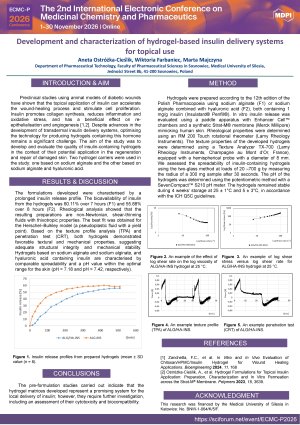
INTRODUCTION. Preclinical and clinical studies indicate that topical insulin may accelerate wound healing by promoting cell proliferation, collagen synthesis, re-epithelialisation, and angiogenesis while reducing inflammation and oxidative stress. The development of effective insulin-containing hydrogels remains challenging. This study aimed to develop and evaluate insulin-loaded hydrogels for potential application in skin regeneration and repair. Two carriers were investigated: sodium alginate and a sodium alginate–hyaluronic acid combination.
MATERIALS AND METHODS. Hydrogels containing 1 mg/g insulin (Insulatard® Penfill®) were prepared according to the 12th edition of the Polish Pharmacopoeia using sodium alginate (F1) or sodium alginate with hyaluronic acid (F2). In vitro insulin release was evaluated using a paddle apparatus with Enhancer Cell™ chambers and a Strat-M® membrane. Rheological properties were determined using an RM 200 Touch rotational rheometer (Lamy Rheology Instruments). We assessed the spreadability of insulin-containing hydrogels using the two-glass method at loads of 20–700 g by measuring the radius of a 300 mg sample after 30 seconds. The pH of the hydrogels was determined using the potentiometric method with a SevenCompact™ S210 pH meter. The hydrogels remained stable during 4 weeks’ storage at 25±1°C and 5±3°C, in accordance with the ICH Q5C guidelines.
RESULTS. The formulations developed were characterised by a prolonged insulin release profile. The bioavailability of insulin from the hydrogels was 60.11% over 7 hours (F1) and 55.88% over 8 hours (F2). Rheological analysis showed that the resulting preparations are non-Newtonian, shear-thinning fluids with thixotropic properties. The best fit was obtained for the Herschel–Bulkley model (a pseudoplastic fluid with a yield point). Hydrogels based on sodium alginate and sodium alginate, and hyaluronic acid containing insulin are characterised by comparable spreadability and a pH value within the optimal range for the skin (pH = 7.18 and pH = 7.42, respectively).
CONCLUSIONS. The pre-formulation studies carried out indicate that the hydrogel matrices developed represent a promising system for the local delivery of insulin; however, they require further investigation, including an assessment of their cytotoxicity and biocompatibility.
This research was financed by the Medical University of Silesia in Katowice: No. BNW-1-064/K/5/F.
Keywords
insulin
hydrogel
hyaluronic acid
sodium alginate
topical delivery
Poster
A.Ostróżka-Cieślik poster.pdf
Green-by-Design Biodegradable Elastomeric Implants for Solvent-Free, Long-Acting Protein Delivery
Narrowing the Experimental Space: Quality by Design-Guided Early-Stage Development of Lipid–Polymer Hybrid Nanoparticles