Event submissions
EventsThe 2nd International Electronic Conference on Medicinal Chemistry and Pharmaceutics
Published
This submission belongs to the session S9. Formulation, Drug Delivery, and Controlled Release of the event The 2nd International Electronic Conference on Medicinal Chemistry and Pharmaceutics
Published date
28 Oct, 2026
Academic Editor
 Maria Emília Sousa
Contribution&Funding
Conceptualization,
[João G. Costa] ; [Ana Júlio]
Methodology,
[Ana Júlio]
Formal analysis,
[Marta Barata Martins]
Investigation,
[Inês Pereira] ; [Marta Barata Martins]
Writing - original draft,
[João G. Costa] ; [Ana Júlio]
Writing - review,
[editing] ; [João G. Costa] ; [Ana Júlio]
Supervision,
[João G. Costa] ; [Ana Júlio]
Project administration,
[João G. Costa] ; [Ana Júlio]
Funding: This work was funded by FCT – Foundation for Science and Technology, I.P. [DOI https://doi.org/10.54499/UID/04567/2025].
Citation
Inês Pereira, Marta Barata Martins, João G. Costa, Ana Júlio, Cryo- and Lyoprotective Performance of Cholinium Amino Acid Ionic Liquids in TransfersomILs, in Proceedings of The 2nd International Electronic Conference on Medicinal Chemistry and Pharmaceutics, 1 November–30 November 2026, MDPI: Basel, Switzerland
Share
Email
Facebook
Twitter
LinkedIn
Cryo- and Lyoprotective Performance of Cholinium Amino Acid Ionic Liquids in TransfersomILs

Inês Pereira 1
Marta Barata Martins 2

João G. Costa 2

Ana Júlio 2
1. Escola de Ciências e Tecnologias da Saúde (ECTS), Lusófona University, Av do Campo Grande, 376. 1749-024, Lisboa, Portugal
2. Research Center for Biosciences and Health Technologies (CBIOS), Lusófona University, Av do Campo Grande, 376. 1749-024, Lisboa, Portugal
Abstract
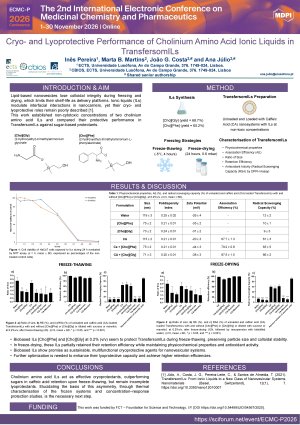
Lipid-based nanovesicles lose colloidal integrity during freezing and drying, which limits their shelf-life as delivery platforms. Ionic liquids (ILs) modulate interfacial interactions in nanocarriers, yet their cryo- and lyoprotective roles remain poorly described. This work established non-cytotoxic concentrations of two cholinium amino acid ILs and compared their protective performance in TransfersomILs against sugar-based protectants.
(2-Hydroxyethyl)trimethylammonium L-phenylalaninate [Cho][Phe] and (2-hydroxyethyl)trimethylammonium glycinate [Cho][Gly] were synthesised, and their cytotoxicity was evaluated in HaCaT keratinocytes by MTT assay after 24 h exposure (0.1–1%, v/v). For both ILs, 0.2% (v/v) was the highest concentration maintaining viability above the predefined 85% threshold. ILs were then incorporated into unloaded and caffeic acid-loaded TransfersomILs, caffeic acid being selected as a model bioactive for its antioxidant activity and limited stability. Size, polydispersity index, zeta potential, association efficiency and DPPH radical scavenging were measured before and after freezing at −5 °C for 4 h followed by thawing, and after freeze-drying (24 h, 0.6 mbar, same freezing step). Sucrose and mannitol, conventional protectants, were used as comparators at 0.2% (w/v), n=3.
ILs reduced vesicle size from 115 to 71–75 nm and raised association efficiency from 68% to 79–88%. After freeze–thawing, final/initial size ratios were 1.1–1.2 for IL-containing systems and 2.5 for the protectant-free control, matching the sugars, while caffeic acid retention reached 93–97%, exceeding both. After freeze-drying, IL size ratios increased to 1.6–1.8, above sucrose and mannitol (1.0–1.1), and retention fell to 89–94%.
Cholinium amino acid ILs act as effective cryoprotectants, outperforming sugars in caffeic acid retention upon freeze–thawing, but remain incomplete lyoprotectants. Elucidating the basis of this asymmetry, through thermal characterisation of the frozen systems and concentration–response protection studies, is the necessary next step.
Keywords
Cholinium ionic liquids
TransfersomILs
Freeze-thawing
Freeze-drying
Caffeic acid
Cytotoxicity
Poster
AnaJulio.pdf
Phytochemical-Potentiated Chitosan Nanoparticles Against Multidrug-Resistant Pseudomonas aeruginosa
POLYMERIC MICRONEEDLES LOADED WITH DIACEREIN MICROSUSPENSION FOR ENHANCED PERCUTANEOUS DRUG DELIVERY