Event submissions
EventsThe 2nd International Electronic Conference on Medicinal Chemistry and Pharmaceutics
Published
This submission belongs to the session S9. Formulation, Drug Delivery, and Controlled Release of the event The 2nd International Electronic Conference on Medicinal Chemistry and Pharmaceutics
Published date
28 Oct, 2026
Academic Editor
 Thierry Vandamme
Contribution&Funding
Conceptualization,
[Maryam Shabbir]
Methodology,
[Maryam Shabbir]
Validation,
[Maryam Shabbir]
Formal analysis,
[Uzair Nagra]
Investigation,
[Uzair Nagra]
Resources,
[Uzair Nagra]
Data curation,
[Uzair Nagra]
Funding: --
Citation
Maryam Shabbir, Uzair Nagra, POLYMERIC MICRONEEDLES LOADED WITH DIACEREIN MICROSUSPENSION FOR ENHANCED PERCUTANEOUS DRUG DELIVERY, in Proceedings of The 2nd International Electronic Conference on Medicinal Chemistry and Pharmaceutics, 1 November–30 November 2026, MDPI: Basel, Switzerland
Share
Email
Facebook
Twitter
LinkedIn
POLYMERIC MICRONEEDLES LOADED WITH DIACEREIN MICROSUSPENSION FOR ENHANCED PERCUTANEOUS DRUG DELIVERY

Maryam Shabbir 1
Uzair Nagra 2
1. Faculty of Pharmacy, The University of Lahore, Lahore, Pakistan
2. Research and Development, Medisearch Pharmacal Pvt. Ltd., Lahore, Pakistan
Abstract
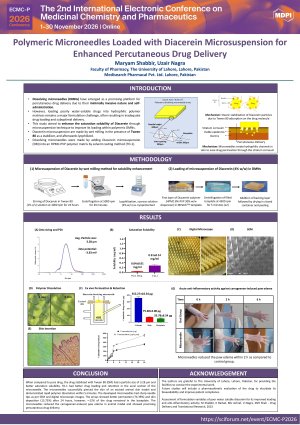
Background: Dissolving microneedles (DMNs) have emerged as a promising platform for percutaneous drug delivery due to their minimally invasive nature and self-administration. However, loading poorly water-soluble drugs into hydrophilic polymer matrices remains a major formulation challenge, often resulting in inadequate drug loading and suboptimal delivery. This study aimed to enhance the saturation solubility of Diacerein through microsuspension technology to improve its loading within polymeric DMNs.
Methodology: A Diacerein microsuspension (DM) was prepared via wet milling method in the presence of Tween 80 as a stabilizer and subsequently lyophilized. DM was incorporated into hydroxypropyl methylcellulose (HPMC) and polyvinylpyrrolidone (PVP) microneedle matrices (DM@MN) using a solvent-casting method. Characterization included particle size analysis, saturation solubility, scanning electron microscopy (SEM), mechanical performance, and Parafilm® M insertion testing. Accelerated stability studies were also conducted.
Results: DM showed a significantly reduced mean particle size (3.28 µm) and improved saturation solubility compared with the untreated drug. DM@MN demonstrated higher drug loading and better retention in the microneedle tips than untreated drug, supporting more efficient delivery potential. SEM imaging confirmed sharp, uniform needle structures. The microneedles effectively pierced excised animal skin and showed rapid polymer dissolution. The arrays showed better permeation (74.39%) and skin deposition (15.75%) after 24 hours, however, ⁓12% of the drug remained in the baseplate.
Conclusion: The microsuspension-based approach significantly enhances loading of Diacerein into dissolving polymeric microneedles. This strategy offers a practical pathway for improving the percutaneous delivery of other therapeutic agents with limited aqueous solubility.
Keywords
Diacerein Microemulsion
Microneedles
Skin Insertion
Poster
ECMC-P2026 Dr. Maryam Shabbir.pdf
Cryo- and Lyoprotective Performance of Cholinium Amino Acid Ionic Liquids in TransfersomILs
A Practical Computational–Experimental Strategy for Drug–Polymer Phase Diagram Prediction and Validation