Event submissions
EventsThe 2nd International Electronic Conference on Medicinal Chemistry and Pharmaceutics
Published
This submission belongs to the session S9. Formulation, Drug Delivery, and Controlled Release of the event The 2nd International Electronic Conference on Medicinal Chemistry and Pharmaceutics
Published date
28 Oct, 2026
Academic Editor
 Maria Emília Sousa
Contribution&Funding
Funding: GAČR (No. 25-15646S); COST Action: CA22107
Citation
Alex Mathers, Michal Fulem, A Practical Computational–Experimental Strategy for Drug–Polymer Phase Diagram Prediction and Validation, in Proceedings of The 2nd International Electronic Conference on Medicinal Chemistry and Pharmaceutics, 1 November–30 November 2026, MDPI: Basel, Switzerland
Share
Email
Facebook
Twitter
LinkedIn
A Practical Computational–Experimental Strategy for Drug–Polymer Phase Diagram Prediction and Validation

Alex Mathers 1
Michal Fulem 1
1. Physical Chemistry, University of Chemistry and Technology, Prague, Prague, 166 28, Czech Republic
Abstract
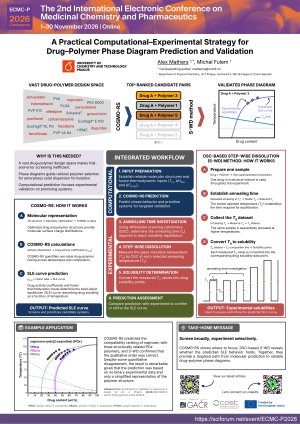
We present an integrated computational–experimental workflow for the efficient construction of binary drug–polymer phase diagrams. COSMO-RS (Conductor-like Screening Model for Real Solvents) predicts solid–liquid equilibrium (SLE) curves, enabling screening and prioritization of candidate drug–polymer pairs for subsequent experimental validation. Prediction accuracy depends strongly on the quality of the input parameters, particularly the fusion thermodynamics of the drug, including melting temperature (Tm), enthalpy of fusion (ΔHfus), and, where known, the change in heat capacity on fusion (ΔCp, fus). Accurate COSMO-RS calculations also require a representative molecular geometry, which is improved by identifying the relevant polymorph via powder X-ray diffraction and differential scanning calorimetry (DSC); experimental crystal structures (e.g., from the Cambridge Structural Database) provide a robust starting point for conformer generation. Experimental verification is performed using the DSC-based step-wise dissolution (S-WD) method, whereby a single supersaturated physical mixture is first used to determine the equilibration time at the lowest annealing temperature. The sample is then held at progressively higher temperatures, with the glass-transition temperature (Tg) measured after each step. Drug solubilities are obtained by mapping the measured Tg values onto a modeled composition–Tg relationship. Compared with the conventional melting point depression (MPD) approach, S-WD avoids the need for multiple sample compositions and mitigates ambiguities associated with onset/peak/offset Tm selection, as well as uncertainties in solubility equilibrium attainment. Together, COSMO-RS and S-WD streamline phase diagram construction, reduce experimental workload, and support the rational design of amorphous solid dispersions.
Keywords
Amorphous solid dispersions
COSMO-RS
differential scanning calorimetry
drug–polymer phase diagrams
solid–liquid equilibrium
step-wise dissolution
Poster
ECMCP_poster_alex-mathers.pdf
POLYMERIC MICRONEEDLES LOADED WITH DIACEREIN MICROSUSPENSION FOR ENHANCED PERCUTANEOUS DRUG DELIVERY
Paeonol Nanoemulgel as a Novel Topical Approach for Accelerated Healing of Diabetic Wounds in Rats