Event submissions
EventsThe 2nd International Electronic Conference on Medicinal Chemistry and Pharmaceutics
Published
This submission belongs to the session S9. Formulation, Drug Delivery, and Controlled Release of the event The 2nd International Electronic Conference on Medicinal Chemistry and Pharmaceutics
Published date
28 Oct, 2026
Academic Editor
 Maria Emília Sousa
Contribution&Funding
Funding: The study is supported by Ministry of Higher Education and Science of Russian Federation (project 1024032800068-4-3.2.2)
Citation
Irina Balashova, Anna Egorova, Anton Kiselev, Combinatorial Delivery of Cancer-Related siRNAs for Suppression of Breast Cancer Cell Proliferation by Electrostatically Stabilized Nucleopeptide Complexes, in Proceedings of The 2nd International Electronic Conference on Medicinal Chemistry and Pharmaceutics, 1 November–30 November 2026, MDPI: Basel, Switzerland
Share
Email
Facebook
Twitter
LinkedIn
Combinatorial Delivery of Cancer-Related siRNAs for Suppression of Breast Cancer Cell Proliferation by Electrostatically Stabilized Nucleopeptide Complexes

Irina Balashova 1,2
Anna Egorova 1

Anton Kiselev 1
1. Lab Molecular Genetics and Gene Therapy, D.O. Ott Research Institute of Obstetrics, Gynecology and Reproductology, Saint Petersburg, Russia
2. Department of Genetics and Biotechnology, Saint Petersburg State University, Saint Petersburg, Russia
Abstract
Breast cancer is one of the most common oncological diseases among women. Although chemotherapy is a mainstay of its treatment, it reduces or eliminates fertility in women, necessitating alternative approaches. RNA interference has emerged as a promising strategy allowing suppression of oncogene expression. However, the key problem is siRNA delivery into target cells. Peptide carriers show considerable potential, providing efficient and specific siRNA delivery.
This work aimed to evaluate the efficacy of inhibiting breast cancer cell proliferation and migration via peptide-mediated combinatorial siRNA delivery.
The carrier system R6Hp/E9H4/E6p, composed of arginine, histidine, and glutamic acid residues, was formulated with siRNA at P/N/C (phosphate/nitrogen/carboxyl) ratios of 1/16/16 against COL4A2 and CDC20 targets responsible for proliferative activity in MDA-MB-231 triple-negative breast cancer cells. An inhibition of proliferation and migration was assessed using the resazurin test and the scratch assay.
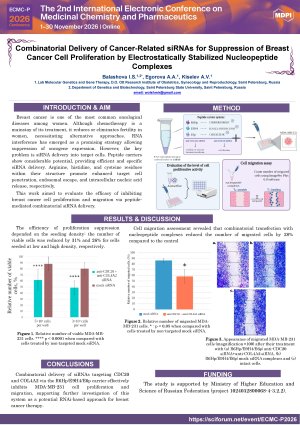
Assessing the anti-proliferative activity of nucleopeptide complexes, a significant decrease in the number of viable cells was revealed compared to the control (complexes with non-targeted siRNA). The efficiency of proliferation suppression depended on the seeding density: the number of viable cells was reduced by 31% and 26% for cells seeded at low and high density, respectively (p < 0.0001). Cell migration assessment revealed that combinatorial transfection with nucleopeptide complexes reduced the number of migrated cells by 28% compared to the control (p < 0.05).
Thus, combinatorial delivery of siRNAs targeting CDC20 and COL4A2 via the R6Hp/E9H4/E6p carrier effectively inhibits MDA-MB-231 cell proliferation and migration, supporting further investigation of this system as a potential RNAi-based approach for breast cancer therapy.
Keywords
breast cancer; RNAi; peptide-based carriers; CDC20; COL4A2
Poster
Combinatorial Delivery of Cancer-Related siRNAs for Suppression of Breast Cancer Cell Proliferation by Electrostatically Stabilized Nucleopeptide Complexes.pdf
Levofloxacin–pimelic acid multicomponent crystal: enhanced stability and biological properties
Smart Dual-Coated Polymersomes for Colon-Targeted Delivery of Repurposed Vardenafil in Ulcerative Colitis