Event submissions
EventsThe 2nd International Electronic Conference on Medicinal Chemistry and Pharmaceutics
Published
This submission belongs to the session S9. Formulation, Drug Delivery, and Controlled Release of the event The 2nd International Electronic Conference on Medicinal Chemistry and Pharmaceutics
Published date
28 Oct, 2026
Academic Editor
 Francisco Javier Otero Espinar
Contribution&Funding
Funding: The authors declare that no financial support or funding was received for the research, authorship, or publication of this article.
Citation
Majedeh TaheriAkerdi, Reyhaneh Danaeipour, Morteza Yousefzadi, Integrated Computational and Experimental Investigation of LDPE Nanoplastic-Induced Destabilization of Polysorbate 80 Micellar Systems for Paclitaxel Delivery, in Proceedings of The 2nd International Electronic Conference on Medicinal Chemistry and Pharmaceutics, 1 November–30 November 2026, MDPI: Basel, Switzerland
Share
Email
Facebook
Twitter
LinkedIn
Integrated Computational and Experimental Investigation of LDPE Nanoplastic-Induced Destabilization of Polysorbate 80 Micellar Systems for Paclitaxel Delivery

Majedeh TaheriAkerdi 1
Reyhaneh Danaeipour 2
Morteza Yousefzadi 2
1. Department of Biotechnology, Faculty of Science and Strategic Technologies, University of Qom, Qom, Iran
2. Department of Biology, Faculty of Basic Science, University of Qom, Qom, Iran
Abstract
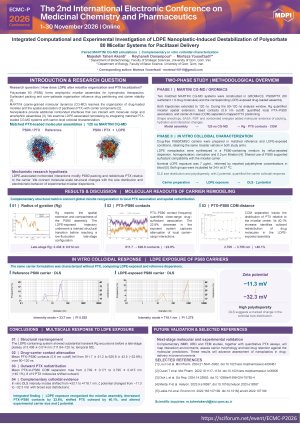
The increasing prevalence of nanoplastics has raised concerns about their potential interactions with nanoscale drug delivery systems and their effects on carrier stability and drug retention. This study combined MARTINI based coarse grained molecular dynamics with physicochemical characterization to investigate the influence of low density polyethylene nanoplastics on polysorbate 80 micelles used for paclitaxel delivery. Molecular dynamics systems containing 60 polysorbate 80 molecules and 9 paclitaxel molecules were simulated for 60 ns and compared in the presence and absence of LDPE nanoplastics. Structural organization and drug carrier interactions were evaluated using the principal moments of inertia, radius of gyration, solvent accessible surface area, root mean square deviation, radial distribution function, and energy analyses. In the absence of LDPE, the paclitaxel loaded micellar system remained relatively stable and showed moderate structural anisotropy, with a PMI anisotropy ratio of 0.236. The radius of gyration increased from approximately 2.8 nm for the polysorbate 80 micelle to 5.27 nm after incorporation of paclitaxel, while solvent accessible surface area values became relatively stable after about 40 ns. Radial distribution analysis showed a preferential association of paclitaxel with the hydrophobic tail region of polysorbate 80, with the strongest enrichment between 2.5 and 3.5 nm. RMSD and energy analyses further supported structural equilibration and reduced contact between paclitaxel and water. The presence of LDPE altered micellar organization and stability and showed behavior consistent with aggregation. Experimental characterization supported these observations. Synthesized LDPE nanoplastics smaller than 200 nm shifted the dominant DLS population from approximately 33.7 to 718.1 nm and changed the zeta potential from −11.3 to −32.3 mV. Overall, the findings indicate that LDPE nanoplastics can substantially alter the structural and colloidal behavior of polysorbate 80 micelles, with potential consequences for paclitaxel retention and release.
Keywords
Paclitaxel; Polysorbate 80; LDPE nanoplastics; Coarse-grained molecular dynamics; Colloidal stability
Poster
ECMCP2026_Poster_MajedehTaheriAkerdi.pdf
Smart Dual-Coated Polymersomes for Colon-Targeted Delivery of Repurposed Vardenafil in Ulcerative Colitis
Development and characterization of hydrogels containing fisetin-loaded nanostructured lipid carriers for melanoma treatment