Event submissions
EventsThe 2nd International Electronic Conference on Medicinal Chemistry and Pharmaceutics
Published
This submission belongs to the session S9. Formulation, Drug Delivery, and Controlled Release of the event The 2nd International Electronic Conference on Medicinal Chemistry and Pharmaceutics
Published date
28 Oct, 2026
Academic Editor
 Thierry Vandamme
Citation
Mara Macedo, Ana Camila Marques , Ana Alves, Maria Helena Amaral, Jorge F. B. Pereira, Development and characterization of hydrogels containing fisetin-loaded nanostructured lipid carriers for melanoma treatment, in Proceedings of The 2nd International Electronic Conference on Medicinal Chemistry and Pharmaceutics, 1 November–30 November 2026, MDPI: Basel, Switzerland
Share
Email
Facebook
Twitter
LinkedIn
Development and characterization of hydrogels containing fisetin-loaded nanostructured lipid carriers for melanoma treatment

Mara Macedo 1
Ana Camila Marques 2
Ana Alves 3
Maria Helena Amaral 2

Jorge F. B. Pereira 4
1. Faculty of Science and Technology of University of Coimbra, University of Coimbra, Portugal
2. UCIBIO i4HB - Faculty of Pharmacy, University of Porto; MEDTECH - Pharmaceutical Technology Laboratory, Faculty of Pharmacy, University of Porto, University of Porto, Portugal
3. UCIBIO i4HB - Faculty of Pharmacy, University of Porto, University of Porto, Portugal
4. CERES, Department of Chemical Engineering, Faculty of Science and Technology of University of Coimbra, University of Coimbra, Portugal
Abstract
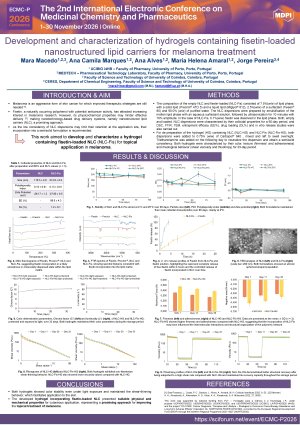
Melanoma is an aggressive form of skin cancer for which improved therapeutic strategies are still needed. Fisetin, a naturally occurring polyphenol with potential anticancer activity, has attracted increasing interest in melanoma research. However, its physicochemical properties may hinder effective delivery, making nanotechnology-based drug delivery systems, namely nanostructured lipid carriers (NLC), a promising approach. Because the liquid nature of NLC dispersions may limit their retention at the application site, incorporation into a semisolid formulation is recommended. Therefore, this work aimed to develop and characterize a hydrogel containing fisetin-loaded NLC (NLC-Fis) for topical application in melanoma. Unloaded NLC and NLC-Fis were prepared by emulsification of the molten lipid phase with an aqueous surfactant solution, followed by ultrasonication. Nearly spherical NLC and NLC-Fis exhibited mean particle sizes of 179.3 ± 2.8 and 214.8 ± 8.2 nm, respectively, with low polydispersity and suitable zeta potential, and remained physically stable for 90 days. Approximately 88% of the drug was incorporated, likely in an amorphous or molecularly dispersed state within the semicrystalline lipid matrix. This resulted in sustained release over 24 hours, unlike free fisetin, which was completely released within 4 hours. Both NLC dispersions were then gelled with Carbopol® 940 and characterized for color, texture, and rheological properties over 33 days. The hydrogels showed color stability even under light exposure and maintained favorable characteristics for application to the skin, including shear-thinning behavior that may facilitate spreading and good structural recovery. These findings highlight the potential of this formulation for topical fisetin delivery in melanoma.
Keywords
Fisetin
Melanoma
Nanostructured lipid carriers
Hydrogel
Poster
Development and characterization of hydrogels containing fisetin loaded nanostructured lipid carriers for melanoma treatment.pdf
Integrated Computational and Experimental Investigation of LDPE Nanoplastic-Induced Destabilization of Polysorbate 80 Micellar Systems for Paclitaxel Delivery
Formulation Development and Evaluation of Kattha-Loaded Rectal Suppository for Hemorrhoidal Management