Event submissions
EventsThe 2nd International Electronic Conference on Medicinal Chemistry and Pharmaceutics
Published
This submission belongs to the session S9. Formulation, Drug Delivery, and Controlled Release of the event The 2nd International Electronic Conference on Medicinal Chemistry and Pharmaceutics
Published date
28 Oct, 2026
Academic Editor
 Francisco Javier Otero Espinar
Citation
Darya Nikolaevna Zinovyeva, Vasilina Alexandrovna Zakharova, Ivan Viktorovich Romashkin, Elena Dmitrievna Nikolskaya, Nikita Grigorievich Yabbarov, Polycation-stabilized alginate-based hydrogels for the regeneration of skin and mucous membranes, in Proceedings of The 2nd International Electronic Conference on Medicinal Chemistry and Pharmaceutics, 1 November–30 November 2026, MDPI: Basel, Switzerland
Share
Email
Facebook
Twitter
LinkedIn
Polycation-stabilized alginate-based hydrogels for the regeneration of skin and mucous membranes

Darya Nikolaevna Zinovyeva 1

Vasilina Alexandrovna Zakharova 1
Ivan Viktorovich Romashkin 1

Elena Dmitrievna Nikolskaya 1,2

Nikita Grigorievich Yabbarov 1,2
1. Institute of Biomedical Engineering, National University of Science and Technology «MISIS», Moscow, 119049, Russia
2. ., N.M. Emanuel Institute of Biochemical Physics RAS (IBCP RAS), Moscow, Russia
Abstract
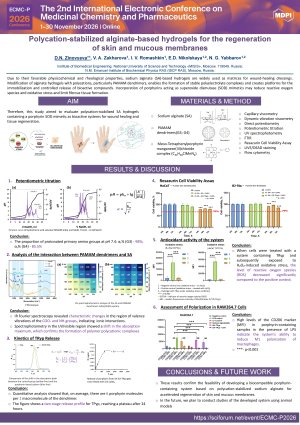
Due to their favorable physicochemical and rheological properties, sodium alginate (SA)-based hydrogels are widely used as matrices for wound-healing dressings. Modification of alginate hydrogels with polycations, particularly PAMAM dendrimers, enables the formation of stable polyelectrolyte complexes and creates platforms for the immobilization and controlled release of bioactive compounds. Incorporation of porphyrins acting as superoxide dismutase (SOD) mimetics may reduce reactive oxygen species and oxidative stress and limit fibrous tissue formation. Therefore, this study aimed to evaluate polycation-stabilized SA hydrogels containing a porphyrin SOD mimetic as bioactive systems for wound healing and tissue regeneration.
The study utilized high-molecular-weight SA, third- and fourth-generation PAMAM dendrimers (G3 and G4), and Mn(III)TnHex-2-PYP (TPyp). Potentiometric titration showed a high degree of protonation of PAMAM primary amino groups at pH 7.4, reaching 98% for G3 and 85.53% for G4, confirming their cationic activity and ability to complex with SA. Formation of SA-PAMAM polyelectrolyte complexes was confirmed by FTIR spectroscopy and UV spectrophotometry. The possibility of incorporating TPyp into G3 and G4 dendrimers was subsequently investigated. Porphyrin release kinetics and the effects of the nature and concentration of calcium chloride and calcium sulfate crosslinkers on release from SA-PAMAM hydrogels were evaluated; the maximum released fraction reached 96.8%.
The biological properties of the developed hydrogel systems were then assessed. The hydrogels showed no significant cytotoxicity toward HaCaT keratinocytes and BJ-5ta fibroblasts. Under induced oxidative stress, treatment with hydrogel extracts reduced the proportion of DCFDA-positive cells from 56.31% to 11.41% in HaCaT cells and from 54.55% to 1.85% in BJ-5ta cells. In addition, the TPyp-containing system promoted macrophage polarization toward the anti-inflammatory M2 phenotype, indicating a potential pro-regenerative effect.
These results confirm the feasibility of developing a biocompatible porphyrin-containing system based on polycation-stabilized sodium alginate for accelerated regeneration of skin and mucous membranes.
Keywords
sodium alginate; PAMAM dendrimers; hydrogel; SOD mimetic; porphyrin; controlled release; wound healing
Poster
Zinovyeva Darya_ECMC-P 2026.pdf
Polymers and Formulation Approaches for Floating In-Situ Gels
From bench to 500 mL: scale-up and characterization of nanostructured lipid carriers