Event submissions
EventsThe 2nd International Electronic Conference on Medicinal Chemistry and Pharmaceutics
Published
This submission belongs to the session S9. Formulation, Drug Delivery, and Controlled Release of the event The 2nd International Electronic Conference on Medicinal Chemistry and Pharmaceutics
Published date
28 Oct, 2026
Academic Editor
 Maria Emília Sousa
Contribution&Funding
Conceptualization,
[Shady Swidan] ; [Mohamed El-Nabarawi] ; [Nahla Ahmed Elhesaisy] ; [Mahmoud Teaima]
Methodology,
[Nahla Ahmed Elhesaisy]
Software,
[Nahla Ahmed Elhesaisy]
Validation,
[Shady Swidan] ; [Mohamed El-Nabarawi] ; [Mahmoud Teaima]
Formal analysis,
[Nahla Ahmed Elhesaisy]
Investigation,
[Nahla Ahmed Elhesaisy]
Data curation,
[Nahla Ahmed Elhesaisy]
Writing - original draft,
[Nahla Ahmed Elhesaisy]
Writing - review,
[editing] ; [Mohamed El-Nabarawi] ; [Mahmoud Teaima] ; [Shady Swidan]
Visualization,
[Mahmoud Teaima] ; [Mohamed El-Nabarawi] ; [Shady Swidan]
Supervision,
[Mohamed El-Nabarawi] ; [Mahmoud Teaima] ; [Shady Swidan]
Funding: --
Citation
Nahla Ahmed Elhesaisy, Shady Swidan, Mahmoud Teaima, Mohamed El-Nabarawi, HSPiP Guided and QbD Optimization of Core-Shell Polymeric Nanoparticles for Enhancing the Delivery of Nutraceutical Bioactive Compound, in Proceedings of The 2nd International Electronic Conference on Medicinal Chemistry and Pharmaceutics, 1 November–30 November 2026, MDPI: Basel, Switzerland
Share
Email
Facebook
Twitter
LinkedIn
HSPiP Guided and QbD Optimization of Core-Shell Polymeric Nanoparticles for Enhancing the Delivery of Nutraceutical Bioactive Compound

Nahla Ahmed Elhesaisy 1,2
Shady Swidan 2
Mahmoud Teaima 3
Mohamed El-Nabarawi 3
1. Postgraduate Program in Pharmaceutics, Faculty of Pharmacy, Cairo University, Cairo, 11562, Egypt
2. Department of Pharmaceutics and Pharmaceutical Technology, Faculty of Pharmacy, The British University in Egypt, El-Sherouk City, Cairo, 11837, Egypt
3. Department of Pharmaceutics and Industrial Pharmacy, Faculty of Pharmacy, Cairo University, Cairo, 11562, Egypt
Abstract
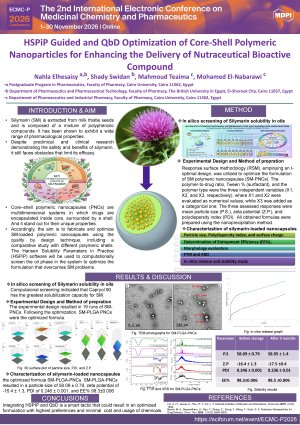
Silymarin is an antioxidant compound with multiple proven pharmacological benefits, but it faces several obstacles that hinder its full efficacy, including poor solubility and bioavailability, as well as a short half-life. Therefore, encapsulating SM in core-shell polymeric nanocapsules can overcome those obstacles and control its release, thereby improving SM properties overall. The HSPIP computational screening approach is a sustainable and inexpensive alternative to the standard wet-lab screening method, which is exceedingly costly, time-consuming, and associated with significant chemical and solvent usage. In this study, the HSPIP computational screening method was used to calculate the solubility of SM in 13 different liquid lipids. QbD (quality by design) was further used to optimize formulation parameters, resulting in the optimized formula SM-PLGA-PNCs. SM-PLGA-PNCs resulted in particle size of 58.09 ± 0.79, zeta potential of 16.4 ± 1.3, PDI of 0.246 ± 0.001, and EE% 98.3±0.006. It was characterized by TEM, which revealed a morphology of uniformly sized spherical capsules, with no visible agglomerates. Additionally, FTIR was conducted to evaluate drug interactions and chemical properties, and showed compatibility between SM and the polymer, confirming the successful encapsulation of SM in SM-PLGA-PNCs. An XRD study was also conducted, confirming the FTIR results. Moreover, an in-vitro release study comparing the SM suspension and SM-PLGA-PNCs demonstrated the controlled-release effect of the optimized formula relative to the SM suspension.
Keywords
HSPiP - Polymeric nanoparticles - Controlled release
Poster
Nahla Elhesaisy E Poster Sciforum-210864.pdf
Chia Meets Chitosan: Nanomedicine for Lung Cancer
Resveratrol Niosomal Gel: Formulation Optimization, In Vitro Evaluation, and Ex Vivo Assessment