Event submissions
EventsThe 2nd International Electronic Conference on Medicinal Chemistry and Pharmaceutics
Published
This submission belongs to the session S9. Formulation, Drug Delivery, and Controlled Release of the event The 2nd International Electronic Conference on Medicinal Chemistry and Pharmaceutics
Published date
28 Oct, 2026
Academic Editor
 Maria Emília Sousa
Contribution&Funding
Conceptualization,
[Shradha Shivdayal Tiwari]
Methodology,
[Shradha Shivdayal Tiwari]
Investigation,
[Shradha Shivdayal Tiwari]
Resources,
[Shradha Shivdayal Tiwari]
Data curation,
[Shradha Shivdayal Tiwari]
Writing - original draft,
[Shradha Shivdayal Tiwari]
Visualization,
[Shradha Shivdayal Tiwari]
Project administration,
[Shradha Shivdayal Tiwari]
Funding: NA
Citation
Shradha Shivdayal Tiwari, Resveratrol Niosomal Gel: Formulation Optimization, In Vitro Evaluation, and Ex Vivo Assessment, in Proceedings of The 2nd International Electronic Conference on Medicinal Chemistry and Pharmaceutics, 1 November–30 November 2026, MDPI: Basel, Switzerland
Share
Email
Facebook
Twitter
LinkedIn
Resveratrol Niosomal Gel: Formulation Optimization, In Vitro Evaluation, and Ex Vivo Assessment

Shradha Shivdayal Tiwari 1
1. School of Pharmacy, Department of Pharmaceutics, MIT Vishwaprayag University, Solapur, Solapur, 413255, India
Abstract
Aim / Background
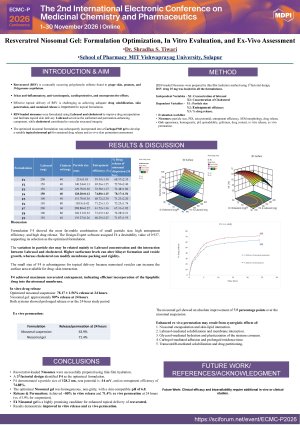
The present study focuses on the formulation and evaluation of a novel resveratrol (RSV) niosomal gel aimed at enhancing solubility, permeability, and sustained drug release.
Material and method
RSV-entrapped niosomes were formulated using the thin film hydration method and incorporated into a gel using carbopol-940 as the gelling agent. To optimize the formulation, a 3² factorial design was employed, varying the ratios of labrasol and cholesterol to achieve ideal niosomal characteristics. The RSV niosomes were assessed for particle size, entrapment efficiency, and in vitro dissolution profiles.
Result
Dynamic light scattering analysis revealed particle sizes ranging from 128 to 288 nm, zeta potentials of -27 to -15 mV, and drug release of 65-78%. The optimized formulation demonstrated an improved drug release of 78.17%, a small particle size of 128 nm, and a stable zeta potential of -14 mV, making it suitable for further development. The optimized niosomal formulation was then integrated into a gel, which was evaluated for both in vitro and ex vivo drug release. The in vitro release study using a dialysis membrane indicated enhanced diffusion and sustained release properties, with an 80% drug release after 24 hours. Ex vivo permeation studies revealed 71.4% drug release, demonstrating the potential for improved skin permeability and bioavailability.
Conclusion
These findings suggest that the use of a lipid mixture (labrasol and cholesterol) in the niosomal formulation not only enhances solubility and permeability but also provides a promising sustained-release system for resveratrol, making it a viable candidate for the treatment of inflammatory diseases. The advancements in formulation, coupled with comprehensive evaluation techniques, underscore the novelty of this study in addressing the challenges of resveratrol delivery through niosomal gels.
Keywords
Resveratrol
Noisome
Gel
Entrapment efficiency
Particle size
ex vivo drug release
in vitro drug release.
Poster
ECMC_MDPI_Poster RSV.pdf
HSPiP Guided and QbD Optimization of Core-Shell Polymeric Nanoparticles for Enhancing the Delivery of Nutraceutical Bioactive Compound
Resveratrol-loaded sericin-elastin nanoblends as innovative cosmeceutical formulation