Event submissions
EventsThe 2nd International Electronic Conference on Medicinal Chemistry and Pharmaceutics
Published
This submission belongs to the session S9. Formulation, Drug Delivery, and Controlled Release of the event The 2nd International Electronic Conference on Medicinal Chemistry and Pharmaceutics
Published date
28 Oct, 2026
Academic Editor
 Thierry Vandamme
Contribution&Funding
Conceptualization,
[Andreea Simona Baltac]
Methodology,
[Andreea Simona Baltac] ; [Raul - Augustin Mitran] ; [Florina Zorila]
Formal analysis,
[Andreea Simona Baltac] ; [Irina Atkinson] ; [Claudia-Ioana Draghici] ; [Daniela Culita] ; [Daniel Negut] ; [Raluca Elena Ginghina]
Investigation,
[Daniel Negut] ; [Raul - Augustin Mitran] ; [Florina Zorila] ; [Claudia-Ioana Draghici] ; [Raluca Elena Ginghina] ; [Daniela Culita] ; [Irina Atkinson] ; [Andreea Simona Baltac]
Resources,
[Andreea Simona Baltac] ; [Raul - Augustin Mitran]
Data curation,
[Andreea Simona Baltac] ; [Raul - Augustin Mitran]
Writing - original draft,
[Andreea Simona Baltac]
Writing - review,
[editing] ; [Raul - Augustin Mitran]
Visualization,
[Andreea Simona Baltac]
Supervision,
[Raul - Augustin Mitran]
Funding: This research was funded by the Romanian Research, Development and Innovation Ministry, grant number PN 23210301.
Citation
Andreea Simona Baltac, Irina Atkinson, Daniela Culita, Daniel Negut, Raluca Elena Ginghina, Claudia-Ioana Draghici, Florina Zorila, Raul - Augustin Mitran, Gamma irradiation mediated synthesis of silver nanoparticles in mesoporous silica particles for combined antimicrobial action, in Proceedings of The 2nd International Electronic Conference on Medicinal Chemistry and Pharmaceutics, 1 November–30 November 2026, MDPI: Basel, Switzerland
Share
Email
Facebook
Twitter
LinkedIn
Gamma irradiation mediated synthesis of silver nanoparticles in mesoporous silica particles for combined antimicrobial action

Andreea Simona Baltac 1
Irina Atkinson 2
Daniela Culita 3
Daniel Negut 1
Raluca Elena Ginghina 4
Claudia-Ioana Draghici 5
Florina Zorila 1

Raul - Augustin Mitran 2
1. Multipurpose Irradiation Facility Center, "Horia Hulubei" National institute for R&D in Physics and Nuclear Engineering (IFIN-HH), Magurele, 077125, Romania
2. Oxide Compounds and Materials Science, “Ilie Murgulescu” Institute of Physical Chemistry, Romanian Academy, Bucharest, Romania, Bucharest, 060021, Romania
3. Coordination and Supramolecular Chemitsry , “Ilie Murgulescu” Institute of Physical Chemistry, Romanian Academy, Bucharest, Romania, Bucharest, 060021, Romania
4. Chemical Technologies for CBRN Defense, Research and Innovation Center for CBRN Defense and Ecology, Bucharest , 041306, Romania
5. Department of Life and Environmental Sciences, "Horia Hulubei" National institute for R&D in Physics and Nuclear Engineering (IFIN-HH), Magurele, 077125, Romania
Abstract
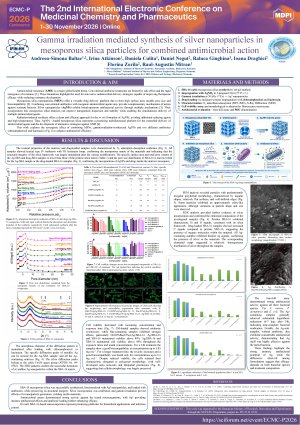
Antimicrobial resistance (AMR) is a major global health challenge, driven by the increasing prevalence of multidrug-resistant microorganisms and the limited development of new antibiotics. Conventional antimicrobial therapy is often compromised by poor bioavailability, systemic toxicity, and inadequate drug concentrations at the infection site, highlighting the need for innovative delivery systems.
Mesoporous silica materials are promising nanocarriers due to their high surface area, tunable pore size, chemical stability, biocompatibility, and ability to provide controlled drug loading and release. In addition, silver nanoparticles (Ag NPs) exhibit broad-spectrum antibacterial activity through multiple mechanisms, including membrane disruption, reactive oxygen species generation, enzyme interference, and DNA damage. Their incorporation into mesoporous silica matrices may enhance nanoparticle stability and dispersion while enabling the simultaneous delivery of multiple antimicrobial agents. Radiation-induced synthesis provides a clean approach for the in situ formation of Ag NPs without additional reducing agents or high temperatures.
In this study, SBA-16 mesoporous silica was employed as a multifunctional carrier for the simultaneous incorporation of gamma-radiation-synthesized Ag NPs and two broad-spectrum antibiotics, chloramphenicol and bacitracin. The resulting systems were characterized by X-ray diffraction, nitrogen adsorption–desorption isotherms, scanning electron microscopy, and energy-dispersive X-ray spectroscopy. Their antimicrobial activity was evaluated using minimum inhibitory concentration and time-kill assays, while cytotoxicity assays were performed to assess biocompatibility.
Ag NPs were successfully synthesized and incorporated into the SBA-16 matrix. The combined Ag NPs/chloramphenicol/bacitracin systems demonstrated pronounced antimicrobial activity, as confirmed by MIC and time-kill assays, while cytotoxicity results supported their potential biocompatibility. Overall, these multifunctional systems represent a promising platform for enhanced antimicrobial therapy and an alternative strategy to address the growing challenge of AMR.
Keywords
mesoporous silica
drug delivery
antimicrobial resistance
silver nanoparticles
gamma radiation
Poster
POSTER Andreea Simona Baltac ECMCP.pdf
Resveratrol-loaded sericin-elastin nanoblends as innovative cosmeceutical formulation
Advanced Formulation and Delivery Strategies for Next-Generation Dengue Vaccines: A Systematic Review