Event submissions
EventsThe 2nd International Electronic Conference on Medicinal Chemistry and Pharmaceutics
Published
This submission belongs to the session S9. Formulation, Drug Delivery, and Controlled Release of the event The 2nd International Electronic Conference on Medicinal Chemistry and Pharmaceutics
Published date
28 Oct, 2026
Academic Editor
 Maria Emília Sousa
Contribution&Funding
Methodology,
[Shahed Ahmadi]
Funding: --
Citation
Mahdi Amirzadeh, Shahed Ahmadi, Advanced Formulation and Delivery Strategies for Next-Generation Dengue Vaccines: A Systematic Review, in Proceedings of The 2nd International Electronic Conference on Medicinal Chemistry and Pharmaceutics, 1 November–30 November 2026, MDPI: Basel, Switzerland
Share
Email
Facebook
Twitter
LinkedIn
Advanced Formulation and Delivery Strategies for Next-Generation Dengue Vaccines: A Systematic Review

Mahdi Amirzadeh 1
Shahed Ahmadi 1
1. Department of Pharmaceutics, School of Pharmacy, Shahid Beheshti University of Medical Sciences, Tehran 1996835113, Iran
Abstract
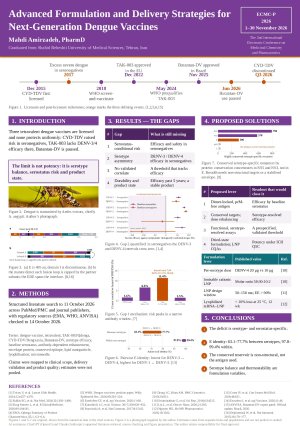
Background: Dengue virus (DENV) infection remains a major global health concern, with four antigenically distinct serotypes requiring balanced and durable immune protection. Despite advances in vaccine development, challenges including serotype imbalance, antibody-dependent enhancement (ADE), variable immunogenicity, limited immune durability, and formulation instability remain significant.
Objective: This systematic review evaluated recent pharmaceutical strategies for improving dengue vaccine development, focusing on advanced antigen engineering, delivery platforms, and formulation optimization technologies.
Methods: A PRISMA 2020-based systematic review was conducted. PubMed, Scopus, and Web of Science were searched using predefined terms related to dengue vaccines, antigen engineering and antigen design, virus-like particles (VLPs), nanoparticles, mRNA platforms, delivery systems, and formulation technologies. Eligible studies were screened and analyzed based on vaccine platforms, delivery approaches, immunogenicity, safety characteristics, and formulation stability.
Results: Among 1530 identified records, 46 studies were included in the qualitative synthesis. Evidence synthesis revealed three major strategies: antigen engineering, advanced delivery systems, and formulation optimization. VLPs, nanoparticle-based platforms, lipid nanoparticle (LNP)-mRNA systems, microneedle technologies, and thermostable formulations demonstrated potential to improve antigen presentation, delivery efficiency, immune responses, and vaccine stability.
Conclusion: Advanced pharmaceutical technologies provide promising opportunities to overcome current limitations in dengue vaccine development. Integration of innovative antigen design, efficient delivery systems, and optimized formulations may contribute to safer, more effective, and accessible dengue vaccines. Further clinical validation and scalable manufacturing studies are required.
Keywords
Keywords: Dengue vaccine; Pharmaceutical formulation; Nanoparticles; Virus-like particles; mRNA delivery;
Poster
Dengue-Poster- Mahdi Amirzadeh.pdf
Gamma irradiation mediated synthesis of silver nanoparticles in mesoporous silica particles for combined antimicrobial action
Exploring the Impact of Nanocarrier Composition in Thermo-responsive Hydrogels