Event submissions
EventsThe 2nd International Electronic Conference on Medicinal Chemistry and Pharmaceutics
Published
This submission belongs to the session S9. Formulation, Drug Delivery, and Controlled Release of the event The 2nd International Electronic Conference on Medicinal Chemistry and Pharmaceutics
Published date
28 Oct, 2026
Academic Editor
 Maria Emília Sousa
Contribution&Funding
Conceptualization,
[Aleksandr Andreevich Nazarov] ; [Gleb Vladimirovich Petrov]
Methodology,
[Aleksandr Andreevich Nazarov]
Formal analysis,
[Aleksandr Andreevich Nazarov]
Investigation,
[Aleksandr Andreevich Nazarov]
Data curation,
[Gleb Vladimirovich Petrov]
Writing - original draft,
[Aleksandr Andreevich Nazarov]
Writing - review,
[editing] ; [Aleksandr Andreevich Nazarov] ; [Gleb Vladimirovich Petrov]
Supervision,
[Gleb Vladimirovich Petrov]
Funding: This publication is supported by the RUDN University Scientific Projects Grant System project № 002093-0-000
Citation
Aleksandr Andreevich Nazarov, Gleb Vladimirovich Petrov, Assessment of the Effect of an Organic Solvent on the Physicochemical Properties of Polymer Nanoparticles, in Proceedings of The 2nd International Electronic Conference on Medicinal Chemistry and Pharmaceutics, 1 November–30 November 2026, MDPI: Basel, Switzerland
Share
Email
Facebook
Twitter
LinkedIn
Assessment of the Effect of an Organic Solvent on the Physicochemical Properties of Polymer Nanoparticles

Aleksandr Andreevich Nazarov 1

Gleb Vladimirovich Petrov 1
1. Department of Pharmaceutical and Toxicological Chemistry, RUDN, Moscow, 117198, Russia
Abstract
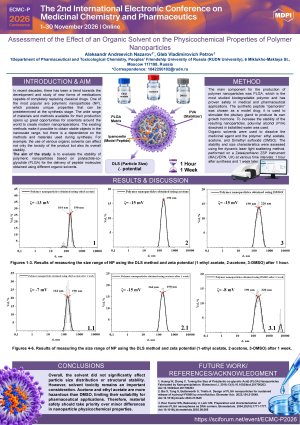
Polymer nanoparticles are promising drug delivery systems that enable drug encapsulation. Their stability and safety depend on synthesis conditions, particularly the choice of organic solvent. This study evaluated the stability of polylactide-co-glycolide nanoparticles for peptide “Ipamorelin” delivery, synthesized using ethyl acetate, acetone, and dimethyl sulfoxide (DMSO). Nanoparticles were prepared by nanoprecipitation using polyvinyl alcohol as a stabilizer. Particle physicochemical characteristics were measured by dynamic light scattering 1 hour after preparation and after one week. All samples remained within the target size range of 100–250 nm. Nanoparticles synthesized with ethyl acetate and DMSO demonstrated multimodal size distributions of 164/190 nm and 190/220 nm, respectively. The acetone-based sample initially exhibited a monomodal distribution with a peak at 190 nm; after one week, a secondary peak at 164 nm appeared, potentially indicating the onset of degradation. The zeta potential of all systems remained between −15 and −5 mV, suggesting overall physical stability. The exception was the ethyl acetate sample, for which the zeta potential shifted from −13 to −7 mV. Overall, the solvent did not significantly affect particle size distribution or structural stability. However, solvent toxicity remains an important consideration. Acetone and ethyl acetate are more hazardous than DMSO, limiting their suitability for pharmaceutical applications. Therefore, material safety should take priority over minor differences in nanoparticle physicochemical properties.
Keywords
nanoparticles
PLGA
Dynamic light scattering
peptides
drug delivery
controlled release
Poster
Poster MDPI. AA Nazarov, GV Petrov.pdf
Phytosomal Based Delivery of Ellagic Acid: Formulation of an Oral Reconstitutable Suspension and Anthelmintic Evaluation
Influence of thermal treatment on doxycycline release from clinoptilolite-rich natural zeolite carriers