Event submissions
EventsThe 2nd International Electronic Conference on Medicinal Chemistry and Pharmaceutics
Published
This submission belongs to the session S9. Formulation, Drug Delivery, and Controlled Release of the event The 2nd International Electronic Conference on Medicinal Chemistry and Pharmaceutics
Published date
28 Oct, 2026
Academic Editor
 Alfredo Berzal-Herranz
Citation
Brenda López, Daylenis Pérez, Luisbel González, Alginate hydrogels with reduced graphene oxide and condensed tannins: formulation programs polyphenol release for wound management, in Proceedings of The 2nd International Electronic Conference on Medicinal Chemistry and Pharmaceutics, 1 November–30 November 2026, MDPI: Basel, Switzerland
Share
Email
Facebook
Twitter
LinkedIn
Alginate hydrogels with reduced graphene oxide and condensed tannins: formulation programs polyphenol release for wound management

Brenda López 1,2
Daylenis Pérez 3

Luisbel González 2
1. Institute of Applied Sciences, Universidad Autónoma de Chile, Santiago, Chile
2. Instituto de Ciencias Aplicadas, Facultad de Ingeniería, Universidad Autónoma de Chile, Santiago, Chile
3. Laboratorio de Biomateriales, Departamento de Ingeniería Química, Facultad de Ingeniería, Universidad de Concepción, Concepción, Chile
Abstract
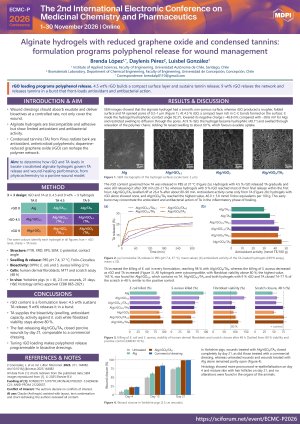
Wound repair requires dressings that deliver bioactive agents in a sustained manner. To this end, borate-crosslinked alginate hydrogels were formulated to carry condensed tannins (TA) from *Pinus radiata* bark, with dopamine-reduced graphene oxide (rGO) as a network modulator. Nine formulations were prepared by combining three rGO and three TA levels (0, 4.5 and 9 wt%) and subjected to physicochemical characterization, swelling and release in PBS (pH 7.4; 37 °C), antioxidant and antibacterial activity, human fibroblast response and in vivo healing in pigs. The rGO content governed the release mechanism. At 4.5%, a compact, hydrophobic and markedly anionic surface layer was formed (−46.8 mV), with power-law exponents below 0.5, indicative of a sustained release controlled by TA diffusion through the pores of the gel. At 9%, network relaxation dominated: release was exhausted within 80 minutes, delivering only 26.4% of the loaded TA. TA determined the biological performance. It raised swelling to 60% of the weight, which favors exudate absorption, and provided antioxidant capacity (46 mg Trolox equivalents/100 g) and activity against *Escherichia coli*. Fibroblast viability reached 145% of the control, indicating that the material stimulates proliferation. In vivo, Alg/rGO9/TA9, the most heavily loaded formulation, closed the wound by day 21, suggesting that its rapid release concentrates antioxidant and antibacterial action in the early inflammatory phase. Overall, rGO loading makes it possible to program polyphenol release in bioactive dressings.
Keywords
Alginate hydrogels; condensed tannins; reduced graphene oxide; controlled release; bioactive dressings; wound healing
Poster
Poster_ECMC-P2026_Sciforum-210347_Lopez.pdf
Influence of thermal treatment on doxycycline release from clinoptilolite-rich natural zeolite carriers
Development and Optimization of a Green Co-Processed Orange Peel Pectin–Flaxseed Mucilage Carrier for Solubility and Dissolution Enhancement of Candesartan Cilexetil