Event submissions
EventsThe 2nd International Electronic Conference on Medicinal Chemistry and Pharmaceutics
Published
This submission belongs to the session S9. Formulation, Drug Delivery, and Controlled Release of the event The 2nd International Electronic Conference on Medicinal Chemistry and Pharmaceutics
Published date
28 Oct, 2026
Academic Editor
 Thierry Vandamme
Contribution&Funding
Funding: This work was carried out within the State Subprogram “Advanced Research in Computational and Environmental Chemistry, Identification of Technological Treatment Processes, Formation of Water Quality and Quantity”, code 010603.
Citation
Oxana Spinu, Igor Povar, Natalia Bolocan, Non-Additive Solubility Enhancement in Multicomponent Drug–Cyclodextrin–L-Arginine Formulations, in Proceedings of The 2nd International Electronic Conference on Medicinal Chemistry and Pharmaceutics, 1 November–30 November 2026, MDPI: Basel, Switzerland
Share
Email
Facebook
Twitter
LinkedIn
Non-Additive Solubility Enhancement in Multicomponent Drug–Cyclodextrin–L-Arginine Formulations

Oxana Spinu 1

Igor Povar 1
Natalia Bolocan 1
1. Institute of Chemistry, Moldova State University, Chisinau, MD2028, Moldova
Abstract
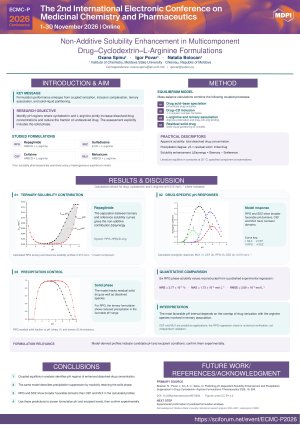
Poor aqueous solubility remains a major limitation in the formulation of many active pharmaceutical ingredients. Cyclodextrins and amino acids can enhance apparent drug solubility through coupled effects involving ionization, inclusion complexation, multicomponent association, and solid–liquid partitioning. When these processes operate simultaneously, the resulting formulation response may become non-additive.
A thermodynamic equilibrium approach was applied to multicomponent systems containing repaglinide, sulfadiazine, cefixime, and meloxicam as representative active pharmaceutical ingredients and L-arginine as the amino acid component. The model accounts for drug protonation, binary drug–cyclodextrin complexation, drug–arginine interactions, ternary association, and precipitation of the free drug over selected pH and composition ranges. Hydroxypropyl-β-cyclodextrin (HPβCD) was included in the quantitatively validated repaglinide system.
Apparent drug solubility and solid-phase fractions were calculated for binary and ternary formulations. Non-additive enhancement was evaluated by comparing the ternary response with the corresponding drug–cyclodextrin system under identical conditions. The calculations show that the contribution of L-arginine is strongly pH-dependent and becomes most pronounced within restricted regions where favorable drug ionization, complex formation, and solid–liquid partitioning occur simultaneously. The largest enhancement is therefore associated with shifts in the coupled equilibrium network rather than with an independent contribution of a single excipient.
Quantitative comparison with published phase-solubility data for the repaglinide–HPβCD–L-arginine system supports the numerical consistency of the approach, while the other drug systems illustrate its predictive applicability. The results show that non-additive solubility enhancement can be interpreted as an emergent response of coupled equilibria and provide a thermodynamic basis for identifying favorable pH and excipient conditions in multicomponent pharmaceutical formulations.
Keywords
Amino acids; Drug solubility; Excipient synergy; Inclusion complexation; Modified β-cyclodextrin; Precipitation suppression
Poster
ECMC_2026_Poster_Spinu.pdf
Preparation and Preliminary Evaluation of a Dissolving Microneedles Delivery System Based on Living Chlamydomonas reinhardtii
Optimising Pharmaceutical Formulations in Resource‑Limited Settings: A Hybrid Deep Learning Approach for Sustained‑Release Tablets