Event submissions
EventsThe 2nd International Electronic Conference on Medicinal Chemistry and Pharmaceutics
Published
This submission belongs to the session S9. Formulation, Drug Delivery, and Controlled Release of the event The 2nd International Electronic Conference on Medicinal Chemistry and Pharmaceutics
Published date
28 Oct, 2026
Academic Editor
 Thierry Vandamme
Citation
Beaven Mariwo, Humphrey Masimba Makumbirofa, Optimising Pharmaceutical Formulations in Resource‑Limited Settings: A Hybrid Deep Learning Approach for Sustained‑Release Tablets, in Proceedings of The 2nd International Electronic Conference on Medicinal Chemistry and Pharmaceutics, 1 November–30 November 2026, MDPI: Basel, Switzerland
Share
Email
Facebook
Twitter
LinkedIn
Optimising Pharmaceutical Formulations in Resource‑Limited Settings: A Hybrid Deep Learning Approach for Sustained‑Release Tablets

Beaven Mariwo 1

Humphrey Masimba Makumbirofa 1
1. Department of Pharmaceutical Technology, School of Allied Health Sciences, Harare Institute of
Technology, Belvedere, Harare, Zimbabwe
Abstract
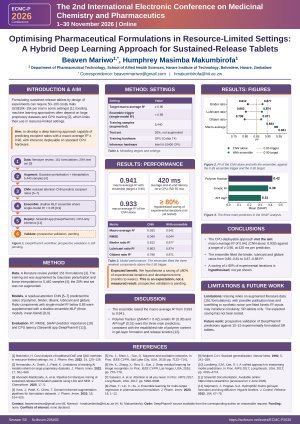
Introduction: Manufacturers in LMICs meet less than 20% of the demand for medical devices. Formulations of sustained-release tablets by means of design of experiments require 50-100 (costly) trials ($10k-15k per trial). Existing machine learning approaches (FormulationNet and PharmaML) depend on large proprietary datasets and GPU training. We intended to develop a CPU-based approach capable of predicting excipient ratios with a macro-average R² ≥ 0.90.
Methods: A literature review yielded 151 formulations. Training was augmented with Gaussian perturbation and linear interpolation to 5,440 training samples. The test set (20%) was not augmented. A residual attention CNN was used to predict the ratios of polymer, binder, diluent, lubricant, and glidant. The ratio components with single-model R² below 0.85 were supplemented with a shallow ensemble MLP (three models, mean blend). A Streamlit app (DeepPharm®) was used for the CPU-only inference.
Results: CNN provided R² = 0.933 and RMSE = 0.049. The ensemble boost increased the macro-average R² to 0.941 (RMSE 0.044), with component-specific improvements for binder_ratio (0.812 to 0.877), lubricant_ratio (0.803 to 0.874), and glidant_ratio (0.798 to 0.871). SHAP analysis revealed that the fraction of polymer (|SHAP| = 0.42), kinetic R² (0.38), and API logP (0.31) were the three main predictors. The average latency of the end-to-end model on an Intel i5-10400 CPU was 420 ms (SD 35 ms).
Discussion: Based on the results, we expect a potential saving of ≥80% of experimental iterations and development timelines, from months to weeks (prospective validation is pending).
Keywords
Sustained‑release tablets
deep learning
CNN‑RNN
pharmaceutical formulation
resource‑limited settings
artificial intelligence
data augmentation
Poster
DeepPharm SR Tablets - Poster.pdf
Non-Additive Solubility Enhancement in Multicomponent Drug–Cyclodextrin–L-Arginine Formulations
Development of a Pre‑Measured Furosemide Oral Granules Kit for Paediatric Heart Failure in Sub‑Saharan Africa Using a Quality‑by‑Design Approach