Event submissions
EventsThe 2nd International Electronic Conference on Medicinal Chemistry and Pharmaceutics
Published
This submission belongs to the session S9. Formulation, Drug Delivery, and Controlled Release of the event The 2nd International Electronic Conference on Medicinal Chemistry and Pharmaceutics
Published date
28 Oct, 2026
Academic Editor
 Thierry Vandamme
Citation
Aris Llamera Moreno, Hannah Yvonne Tabuso Bondoc, Alexa Maceda Dialoja, Shannen Anziel Deaño Tucay, Anthony R. Marin, DEVELOPMENT AND EVALUATION OF CRICKET (Teleogryllus occipitalis) OIL AS A NATURAL LIPID BASE FOR SUPPOSITORY FORMULATION, in Proceedings of The 2nd International Electronic Conference on Medicinal Chemistry and Pharmaceutics, 1 November–30 November 2026, MDPI: Basel, Switzerland
Share
Email
Facebook
Twitter
LinkedIn
DEVELOPMENT AND EVALUATION OF CRICKET (Teleogryllus occipitalis) OIL AS A NATURAL LIPID BASE FOR SUPPOSITORY FORMULATION

Aris Llamera Moreno 1
Hannah Yvonne Tabuso Bondoc 1
Alexa Maceda Dialoja 1
Shannen Anziel Deaño Tucay 1
Anthony R. Marin 2
1. School of Medical Laboratory Sciences, Department of Pharmacy, St. Dominic College of Asia, Bacoor, Cavite, 4102, Philippines
2. Department of Pharmacy, St. Dominic College of Asia, Bacoor, Cavite, 4102, Philippines
Abstract
Background & Objectives: Most key raw materials used in pharmaceutical manufacturing in the Philippines are imported, highlighting the need to explore locally available alternatives (Reyes & Tabuga, 2020). Cricket oil has gained attention as a potential natural lipid source because of its reported antioxidant, anti-inflammatory, and protective biological activities associated with phenolic compounds and phytosterols (Murugu et al., 2024). Although its applications in skincare and food industries have been described, its pharmaceutical use remains limited. This study aimed to extract and characterize Teleogryllus occipitalis oil and evaluate its potential as a natural lipid base for suppository formulation.
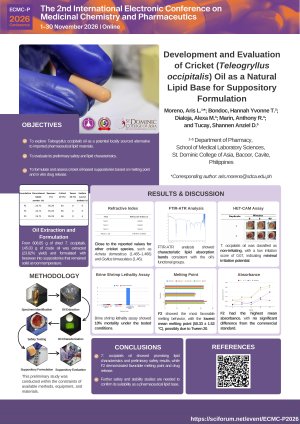
Methods: Teleogryllus occipitalis oil was extracted through pulverization, hexane maceration, vacuum filtration, rotary evaporation, bentonite purification, centrifugation, and decantation. The extracted oil was characterized using refractive index determination and FTIR-ATR analysis. Preliminary safety was assessed through the HET-CAM assay and brine shrimp lethality test. Three paracetamol suppository formulations containing cricket oil and beeswax were prepared, and their melting point and in vitro drug release were evaluated.
Results & Discussion: A total of 145.03 g crude oil was obtained from 608.85 g dried cricket sample, giving a 23.82% yield, which was higher than the 12.39% reported by Ngampeerapong et al. (2024). The oil had a mean refractive index of 1.4618 ± 0.0008, close to values reported for other cricket oils. FTIR-ATR analysis showed characteristic lipid absorption bands. In the HET-CAM assay, T. occipitalis oil was classified as non-irritating, while the brine shrimp lethality test showed only 10% mortality at 100 ppm, suggesting low preliminary toxicity. The oil was successfully formulated with beeswax into solid suppositories. Among the formulations, F2 showed the lowest mean melting point and the most consistent upward drug release pattern.
Keywords
Teleogryllus occipitalis
cricket oil
suppository formulation
paracetamol suppository
in vitro drug release
Poster
Cricket_Oil_Research_Poster.pdf
Development of Trazodone HCl Prolonged-Release Tablets: Formulation Optimization and Dissolution Studies
Photocrosslinkable Hyaluronic Acid-Based Hydrogels for In Situ Drug Delivery and Biomedical Applications