Event submissions
EventsThe 2nd International Electronic Conference on Medicinal Chemistry and Pharmaceutics
Published
This submission belongs to the session S9. Formulation, Drug Delivery, and Controlled Release of the event The 2nd International Electronic Conference on Medicinal Chemistry and Pharmaceutics
Published date
28 Oct, 2026
Academic Editor
 Maria Emília Sousa
Contribution&Funding
Conceptualization,
[Viktoriya Georgiyants] ; [Olha Mykhailenko]
Methodology,
[Olha Mykhailenko] ; [Vasyl Chornyi] ; [Oksana Honchar]
Software,
[Oksana Honchar]
Validation,
[Viktoriya Georgiyants] ; [Olha Mykhailenko] ; [Vasyl Chornyi] ; [Olha Holovchenko]
Formal analysis,
[Oksana Honchar]
Investigation,
[Olha Holovchenko] ; [Vasyl Chornyi] ; [Oksana Honchar]
Resources,
[Vasyl Chornyi]
Data curation,
[Olha Mykhailenko] ; [Viktoriya Georgiyants]
Writing - original draft,
[Oksana Honchar]
Writing - review,
[editing] ; [Olha Holovchenko] ; [Olha Mykhailenko] ; [Vasyl Chornyi]
Visualization,
[Oksana Honchar]
Supervision,
[Vasyl Chornyi] ; [Viktoriya Georgiyants]
Project administration,
[Viktoriya Georgiyants]
Funding: --
Citation
Oksana Honchar, Olha Mykhailenko, Olha Holovchenko, Vasyl Chornyi, Viktoriya Georgiyants, Application of Quality by Design (QbD) in Pharmaceutical Development of Fixed-Dose Combination Containing Herbal Extract and Synthetic Active Ingredient, in Proceedings of The 2nd International Electronic Conference on Medicinal Chemistry and Pharmaceutics, 1 November–30 November 2026, MDPI: Basel, Switzerland
Share
Email
Facebook
Twitter
LinkedIn
Application of Quality by Design (QbD) in Pharmaceutical Development of Fixed-Dose Combination Containing Herbal Extract and Synthetic Active Ingredient

Oksana Honchar 1,2

Olha Mykhailenko 1,3
Olha Holovchenko 1
Vasyl Chornyi 4
Viktoriya Georgiyants 1
1. Department of Pharmaceutical Chemistry, National University of Pharmacy, Kharkiv, 61002, Ukraine
2. Department of Pharmaceutical Chemistry Disciplines, Rivne Medical Academy, Rivne, Ukraine
3. Pharmaceutical Institute, Kiel University, Kiel, Germany
4. R&D Department, JSC «FARMAK», Kyiv, Ukraine
Abstract
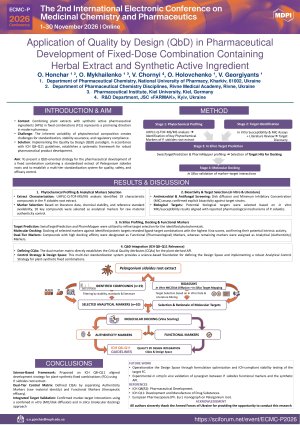
The development of fixed combinations (FCs) containing plant extracts and synthetic active pharmaceutical ingredients (APIs) is a promising area of modern pharmacy. However, the inherent variability of phytochemical composition creates challenges for quality assurance and regulatory compliance. The Quality by Design (QbD) paradigm provides a systematic framework for establishing a robust pharmaceutical development through the identification of critical quality attributes (CQAs), critical process parameters (CPPs), and the design space.
This study presents a QbD-oriented strategy for the pharmaceutical development of an FC containing a standardised extract of Pelargonium sidoides roots. The research approach includes comprehensive analytical characterisation of the extract using UHPLC-Q-TOF-MS/MS to identify key phytochemical markers. The marker profile serves as a basis for defining the CQAs of the plant-derived component. Additionally, the extract is subjected to in vitro biological activity screening to establish antimicrobial and antifungal activity for further justification of the selection of functional markers for efficacy control. Computer modelling is used to identify potential molecular targets of the identified markers, providing a rationale for the selection of pharmacodynamic markers.
The ultimate goal is to establish a multi-tier standardisation system: authenticity markers for raw material identification and functional markers for controlling pharmacological activity relevant to the target FC. This system enables the development of a robust analytical control strategy, supports stability studies, and facilitates the establishment of the design space for the FC composition. The proposed approach aligns with ICH Q8-Q11 guidelines and provides a science-based foundation for the QbD development of plant-synthetic FCs with predefined quality, safety, and efficacy profiles.
Keywords
Quality by Design
Pelargonium sidoides
fixed combination
pharmaceutical development
standardisation
Poster
Honchar_14.10.2026.pdf
Photocrosslinkable Hyaluronic Acid-Based Hydrogels for In Situ Drug Delivery and Biomedical Applications
Substrate-Dependent Reversal of Inhibition and Activation by Hyperbolic Enzyme Modifiers