Event submissions
EventsThe 2nd International Electronic Conference on Medicinal Chemistry and Pharmaceutics
Published
This submission belongs to the session S10. Biopharmaceutics, Disposition, Pharmacokinetics and Pharmacodynamics of the event The 2nd International Electronic Conference on Medicinal Chemistry and Pharmaceutics
Published date
28 Oct, 2026
Academic Editor
 Maria Emília Sousa
Contribution&Funding
Funding: This work is supported by FCT – Portuguese Foundation for Science and Technology, under the projects CITAB (UID/04033/2025, https://doi.org/10.54499/UID/04033/2025) and the Associated Laboratory Inov4Agro (LA/P/0126/2020, https://doi.org/10.54499/LA/P/0126/2020).
Citation
Paula Alexandra Pinto, Substrate-Dependent Reversal of Inhibition and Activation by Hyperbolic Enzyme Modifiers, in Proceedings of The 2nd International Electronic Conference on Medicinal Chemistry and Pharmaceutics, 1 November–30 November 2026, MDPI: Basel, Switzerland
Share
Email
Facebook
Twitter
LinkedIn
Substrate-Dependent Reversal of Inhibition and Activation by Hyperbolic Enzyme Modifiers

Paula Alexandra Pinto 1
1. Department of Biology and Environment, University of Trás-os-Montes and Alto Douro, Vila real, 5000-801, Portugal
Abstract
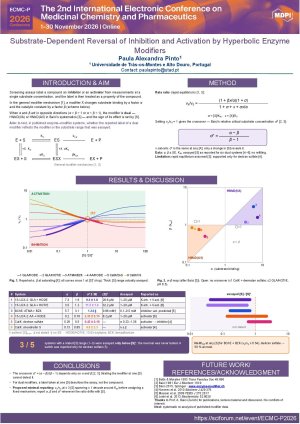
A compound's effect on enzyme activity is frequently assigned as fixed inhibition or activation, independent of the substrate concentration used to measure it. Within the general modifier (Botts–Morales) framework, this characterization becomes conditional whenever a modifier's two coefficients — α, governing substrate binding, and β, governing the catalytic step — act in opposing directions relative to unity. For such a modifier, v/v₀ = (1 + βx/α)(1 + σ)/(1 + σ + x + σx/α), with σ = [S]/K_M and x = [X]/K_x. Setting v/v₀ = 1 yields a crossover substrate concentration σ* = (α − β)/(β − 1), which is positive and physically accessible when the condition for sign reversal is met. A critical and underappreciated consequence follows directly from the form of σ*: because it depends only on α and β, and not on modifier concentration, a complete modifier titration at a fixed substrate concentration produces a convincing dose–response curve while leaving the substrate-dependent inversion entirely undetected. Using published α and β values from three characterized enzyme–modifier systems, we show that σ* falls within accessible substrate ranges, so the same compound is correctly described as a partial inhibitor at one substrate concentration and as an activator at another. This reversal, an exact consequence of the general modifier scheme, has received little attention in the enzyme-activation literature. We propose that a minimal substrate series should be included in the characterization of any modifier assigned a fixed mechanistic classification
Keywords
enzyme kinetics; enzyme–modifier interactions; hyperbolic inhibition; enzyme activation; reporting standards
Poster
poster_ECMCP2026_Pinto_v4_site.pdf
Application of Quality by Design (QbD) in Pharmaceutical Development of Fixed-Dose Combination Containing Herbal Extract and Synthetic Active Ingredient
Cannabidiol and Δ9-Tetrahydrocannabinol in Polypharmacy: Mapping the Potential Clinically Significant Interactions