Event submissions
EventsThe 2nd International Electronic Conference on Medicinal Chemistry and Pharmaceutics
Published
This submission belongs to the session S10. Biopharmaceutics, Disposition, Pharmacokinetics and Pharmacodynamics of the event The 2nd International Electronic Conference on Medicinal Chemistry and Pharmaceutics
Published date
28 Oct, 2026
Academic Editor
 Maria Emília Sousa
Contribution&Funding
Conceptualization,
[Anna Weronika Sobańska]
Methodology,
[Anna Weronika Sobańska]
Validation,
[Anna Weronika Sobańska]
Investigation,
[Anna Weronika Sobańska] ; [Elżbieta Brzezińska]
Writing - original draft,
[Anna Weronika Sobańska]
Funding acquisition,
[Elżbieta Brzezińska]
Funding: Internal grant of the Medical University of Lodz, no. 503/3-016-03/503-31-001
Citation
Anna Weronika Sobańska, Elżbieta Brzezińska, A biomimetic chromatographic and computational approach to the rate of drug passage through the Blood-Brain Barrier, in Proceedings of The 2nd International Electronic Conference on Medicinal Chemistry and Pharmaceutics, 1 November–30 November 2026, MDPI: Basel, Switzerland
Share
Email
Facebook
Twitter
LinkedIn
A biomimetic chromatographic and computational approach to the rate of drug passage through the Blood-Brain Barrier

Anna Weronika Sobańska 1
Elżbieta Brzezińska 1
1. Analytical Chemistry, Medical University of Lodz, Łódź, 90-151, Poland
Abstract
Compounds’ affinity for the CNS is expressed using different parameters, including:
i) log BB (the ratio of the total, equilibrium drug concentration in the brain to that in blood)
ii) log PS expressed in [mL/min/g brain] and obtained via in situ brain perfusion studies using the Renkin-Crone equation: PS = -F∙ln (1-Kin/F), where F is the cerebral blood or perfusion flow rate, Kin = (Qbr/Qpf)/T is the unidirectional transfer constant, Qbr is the concentration, corrected for the vascular volume, of compound in the brain, Qpf is the concentration of a compound in the perfusion fluid, and T is the perfusion time
iii) the unbound brain-to-plasma concentration ratio (Kp,uu,brain) and the unbound CSF (cerebrospinal fluid)-to-plasma concentration ratio (Kp,uu,CSF).
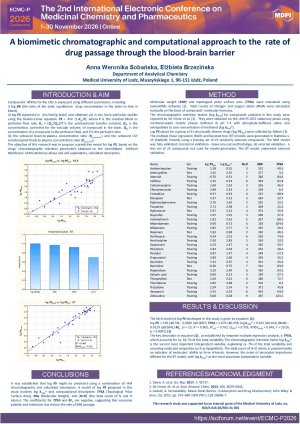
In this study, log PS was predicted for a group of 21 drugs based on experimental reference data. It was established that log PS is related to the Immobilized Artificial Membrane (IAM) chromatographic retention parameter obtained with 100% aqueous mobile phases, log kIAMw – for the correlation between log PS and log kIAMw, Pearson’s R = 0.74 (vs. R = 0.51 for the relationship between log PS and the Micellar Liquid Chromatographic retention data obtained using sodium dodecyl sulfate-based micellar mobile phases). It seemed therefore likely that log PS can be predicted using a combination of IAM chromatographic and calculated descriptors. A model of log PS proposed in this study involved log kIAMw and computational descriptors TPSA (Topological Polar Surface Area), Mw (Molecular Weight), and (N+O) (the total count of N and O atoms). The coefficients for TPSA and Mw are negative, suggesting that excessive polarity and molecular size reduce the rate of BBB passage.
Keywords
Blood-brain permeability
Immobilized Artificial Membrane chromatography
Computational descriptors
Poster
Poster Sobanska AW.pdf
Cannabidiol and Δ9-Tetrahydrocannabinol in Polypharmacy: Mapping the Potential Clinically Significant Interactions
Dosing Inhibition: The Conformational Effect of 1 vs. 2 Dicumarols on NQO1-FAD Inhibition