Event submissions
EventsThe 2nd International Electronic Conference on Medicinal Chemistry and Pharmaceutics
Published
This submission belongs to the session S10. Biopharmaceutics, Disposition, Pharmacokinetics and Pharmacodynamics of the event The 2nd International Electronic Conference on Medicinal Chemistry and Pharmaceutics
Published date
28 Oct, 2026
Academic Editor
 Francisco Javier Otero Espinar
Citation
Ingryd Carolly de Oliveira Medeiros, Antenor Correia da Silva Júnior, Carlos Augusto de Senna Azevedo, Ludmilla da Silva Augusto , Giovanna Isabelle Camilo, José Maria Sombra Júnior, Leticia Nogueira Gurgel de Oliveira, Dayane Aurora dos Santos Fernandes, Mayke Sombra Barbosa, Eveline Matias Bezerra, Roner Ferreira da Costa, Dosing Inhibition: The Conformational Effect of 1 vs. 2 Dicumarols on NQO1-FAD Inhibition, in Proceedings of The 2nd International Electronic Conference on Medicinal Chemistry and Pharmaceutics, 1 November–30 November 2026, MDPI: Basel, Switzerland
Share
Email
Facebook
Twitter
LinkedIn
Dosing Inhibition: The Conformational Effect of 1 vs. 2 Dicumarols on NQO1-FAD Inhibition

Ingryd Carolly de Oliveira Medeiros 1
Antenor Correia da Silva Júnior 1
Carlos Augusto de Senna Azevedo 1
Ludmilla da Silva Augusto 1
Giovanna Isabelle Camilo 2
José Maria Sombra Júnior 1
Leticia Nogueira Gurgel de Oliveira 1
Dayane Aurora dos Santos Fernandes 1
Mayke Sombra Barbosa 1
Eveline Matias Bezerra 1
Roner Ferreira da Costa 1
1. Department of Natural Sciences, Mathematics, and Statistics (DCME), Federal Rural University of the Semi-arid Region (UFERSA), Mossoró, 59625-900, Brazil
2. Department of Biosciences (DBIO), Federal Rural University of the Semi-arid Region (UFERSA), Mossoró, 59625-900, Brazil
Abstract
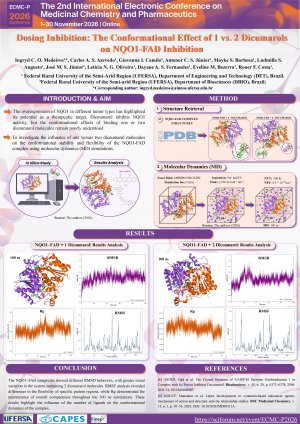
The overexpression of NAD(P)H oxidoreductase 1 (NQO1) in different tumor types has highlighted this enzyme as a potential therapeutic target. Among the known inhibitors of NQO1 is dicoumarol, a coumarin derivative that binds to the enzyme's active site, competes with the NAD(P)H cofactor, and inhibits its catalytic activity. Although the interaction of dicoumarol with NQO1–FAD is known, conformational changes associated with the number of ligands present in the complex remain poorly explored. Therefore, this study used molecular dynamics (MD) simulations to investigate NQO1–FAD systems containing one and two dicoumarol molecules, aiming to compare the stability and flexibility of the ligand. Molecular dynamics simulations were performed using the crystal structure of the NQO1–FAD–dicoumarol complex (PDB ID: 2F1O) as the starting structure, using GROMACS 2025.4, the AMBER99SB-ILDN force field, and the SPC/E water model. Systems containing one or two dicoumarol molecules were neutralized with Na+ and Cl− ions at a concentration of 0.15 mol/L and subjected to energy minimization until the maximum force was below 100.0 kJ/mol. Equilibration was initially performed under the NVT ensemble at 300 K, followed by the NPT ensemble using the Parrinello–Rahman barostat. The resulting trajectories were analyzed using root-mean-square deviation (RMSD), root-mean-square fluctuation (RMSF), radius of gyration (Rg), and principal component analysis (PCA), allowing the influence of the presence of one or two dicoumarol molecules on the conformational behavior of NQO1–FAD to be assessed. The results demonstrated differences in the stability and conformational flexibility of the systems containing one and two dicoumarol molecules. RMSD, RMSF, Rg, and PCA analyses indicated that the number of ligands influences the dynamics of the NQO1–FAD complex, suggesting different conformational patterns as a function of dicoumarol occupancy.
Keywords
Molecular Dynamics
Protein-ligand interaction
Coumarin
Natural drug
Poster
poster.pdf
A biomimetic chromatographic and computational approach to the rate of drug passage through the Blood-Brain Barrier
Cyclodextrin-Engineered Quercetin as a Translational Delivery Platform: A Critical Evidence Synthesis Linking Supramolecular Complexation with Pharmacokinetic and Pharmacodynamic Outcomes