Event submissions
EventsThe 2nd International Electronic Conference on Medicinal Chemistry and Pharmaceutics
Published
This submission belongs to the session S10. Biopharmaceutics, Disposition, Pharmacokinetics and Pharmacodynamics of the event The 2nd International Electronic Conference on Medicinal Chemistry and Pharmaceutics
Published date
28 Oct, 2026
Academic Editor
 Thierry Vandamme
Contribution&Funding
Conceptualization,
[Mekaouche Fatima Zohra Nadjet]
Methodology,
[Mekaouche Fatima Zohra Nadjet]
Investigation,
[Mekaouche Fatima Zohra Nadjet]
Writing - original draft,
[Mekaouche Fatima Zohra Nadjet]
Writing - review,
[editing] ; [Mekaouche Fatima Zohra Nadjet]
Funding: --
Citation
Mekaouche Fatima Zohra Nadjet, Fetati Habiba, Memou Asma, Djoudad Kada, Bendifallah Ibrahim, Zerdoumi Faiza, Boudia Fatma, Toumi Houari, Pharmacokinetic Changes of Calcineurin Inhibitors During Pregnancy: Importance of Therapeutic Drug Monitoring, in Proceedings of The 2nd International Electronic Conference on Medicinal Chemistry and Pharmaceutics, 1 November–30 November 2026, MDPI: Basel, Switzerland
Share
Email
Facebook
Twitter
LinkedIn
Pharmacokinetic Changes of Calcineurin Inhibitors During Pregnancy: Importance of Therapeutic Drug Monitoring

Mekaouche Fatima Zohra Nadjet 1,2
Fetati Habiba 1,2
Memou Asma 1,2
Djoudad Kada 2,3
Bendifallah Ibrahim 2
Zerdoumi Faiza 2,3
Boudia Fatma 1,2
Toumi Houari 1,2
1. Pharmacovigilance Service, EHU Oran, Oran, 31000, Algeria
2. Faculty of Medicine, University of Oran 1 Ahmed Benbella, Oran, 31000, Algeria
3. Nephrology Department, EHU Oran, Oran, 3100, Algeria
Abstract
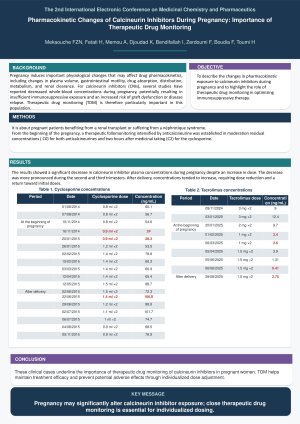
Background: Pregnancy induces physiological changes that can alter the pharmacokinetics of calcineurin inhibitors (CNIs), potentially affecting whole-blood concentrations and dose requirements. Close therapeutic drug monitoring (TDM) is therefore essential to maintain appropriate immunosuppressive therapy during pregnancy and the early postpartum period.
Objective: To characterize changes in CNI concentrations and dose requirements during pregnancy and the early postpartum period, and to highlight the role of TDM in guiding individualized dose adjustment.
Methods: We retrospectively analyzed clinical and TDM data from pregnant patients who had undergone renal transplantation or were treated for nephrotic syndrome with a CNI. The study included five pregnancies. Whole-blood trough concentrations (C0) of tacrolimus and cyclosporine were monitored throughout pregnancy and after delivery. CNI doses and concentrations were evaluated longitudinally, and dose adjustments were performed according to TDM results and the clinical context.
Results: CNI trough concentrations progressively declined during pregnancy, despite dose adjustments, with reductions of approximately 50–95% compared with pre-pregnancy levels and the most pronounced decreases occurring during the second and third trimesters. Dose requirements increased progressively in some cases, with a maximum increase of approximately 88% (1.9-fold) from baseline. Following delivery, CNI concentrations increased markedly, reaching several-fold higher levels than those observed during late pregnancy, prompting subsequent dose adjustments. These findings highlight substantial fluctuations in CNI exposure and dose requirements throughout pregnancy and the early postpartum period.
Conclusion: Pregnancy induces substantial changes in CNI exposure and dose requirements. Close TDM throughout pregnancy and the early postpartum period is essential to guide individualized dose adjustments and maintain therapeutic CNI exposure.
Keywords
.Calcineurin inhibitors
Pregnancy
Pharmacokinetics
Therapeutic drug monitoring
Poster
Pharmacokinetic Changes of Calcineurin Inhibitors During Pregnancy Importance of Therapeutic Drug Monitoring.pdf
Cyclodextrin-Engineered Quercetin as a Translational Delivery Platform: A Critical Evidence Synthesis Linking Supramolecular Complexation with Pharmacokinetic and Pharmacodynamic Outcomes
Can simple UV-Vis measurements with tryptophan serve as a screening model for potential drug-AGP interactions?