Event submissions
EventsThe 2nd International Electronic Conference on Medicinal Chemistry and Pharmaceutics
Published
This submission belongs to the session S10. Biopharmaceutics, Disposition, Pharmacokinetics and Pharmacodynamics of the event The 2nd International Electronic Conference on Medicinal Chemistry and Pharmaceutics
Published date
28 Oct, 2026
Academic Editor
 Mary J. Meegan
Contribution&Funding
Conceptualization,
[Karolina Wanat]
Methodology,
[Karolina Wanat]
Software,
[Karolina Wanat]
Validation,
[Elżbieta Brzezińska]
Formal analysis,
[Karolina Wanat]
Investigation,
[Agata Siniarska]
Resources,
[Agata Siniarska]
Data curation,
[Karolina Wanat]
Writing - original draft,
[Karolina Wanat] ; [Agata Siniarska]
Writing - review,
[editing] ; [Elżbieta Brzezińska]
Visualization,
[Karolina Wanat]
Supervision,
[Elżbieta Brzezińska]
Project administration,
[Karolina Wanat]
Funding acquisition,
[Elżbieta Brzezińska]
Funding: --
Citation
Karolina Wanat, Agata Siniarska, Elżbieta Brzezińska, Can simple UV-Vis measurements with tryptophan serve as a screening model for potential drug-AGP interactions?, in Proceedings of The 2nd International Electronic Conference on Medicinal Chemistry and Pharmaceutics, 1 November–30 November 2026, MDPI: Basel, Switzerland
Share
Email
Facebook
Twitter
LinkedIn
Can simple UV-Vis measurements with tryptophan serve as a screening model for potential drug-AGP interactions?

Karolina Wanat 1
Agata Siniarska 1
Elżbieta Brzezińska 1
1. Department of Analytical Chemistry, Medical University of Lodz, Lodz, 90-151, Poland
Abstract
Alpha-1-acid glycoprotein (AGP) is a key plasma protein involved in the binding and transport of numerous drugs, particularly basic compounds. The aim of this study was to evaluate whether simple UV-Vis measurements using tryptophan as a model component of the AGP binding site could serve as a screening method for assessing potential drug-AGP binding interactions. Thirty drugs with diverse chemical structures were analyzed. UV-Vis spectra were recorded for the drug alone, tryptophan alone, and the drug-tryptophan mixture and the experimental mixture spectra were compared with theoretical additive spectra. A series of parameters describing deviations from additivity, including U, RB, RW, L+W − L and L+W − Add were calculated and subjected to statistical analysis.
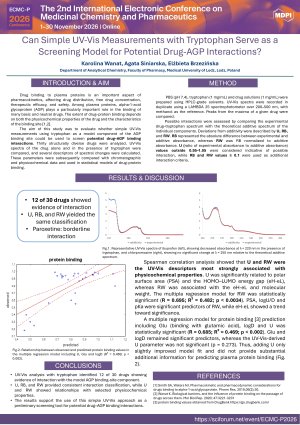
The parameters U, RB and RW consistently identified the same group of 12 drugs showing evidence of interaction with tryptophan. Paroxetine represented a borderline interaction, suggesting a weaker effect than that observed for the remaining compounds. Relationships were also observed between the spectrophotometric parameters and selected physicochemical descriptors, particularly polar surface area and the HOMO–LUMO energy gap. Multiple and logistic regression analyses indicated that selected physicochemical properties contributed to the differentiation between interacting and non-interacting compounds. Overall, the results suggest that UV-Vis measurements with tryptophan may provide a simple screening approach for the preliminary assessment of potential drug-AGP binding interactions, particularly when combined with physicochemical and chromatographic descriptors.
Keywords
alpha-1-acid glycoprotein
drug–protein binding
UV-Vis spectrophotometry
tryptophan
pharmacokinetics
Poster
Wanat poster ECMC-P 2026.pdf
Pharmacokinetic Changes of Calcineurin Inhibitors During Pregnancy: Importance of Therapeutic Drug Monitoring
Acebutolol Attenuates Glycoxidative Stress and Alters mTOR-Associated Phosphoprotein Signaling in Hyperglycemic HUVECs