Event submissions
EventsThe 2nd International Electronic Conference on Medicinal Chemistry and Pharmaceutics
Published
This submission belongs to the session S10. Biopharmaceutics, Disposition, Pharmacokinetics and Pharmacodynamics of the event The 2nd International Electronic Conference on Medicinal Chemistry and Pharmaceutics
Published date
28 Oct, 2026
Academic Editor
 Maria Emília Sousa
Contribution&Funding
Conceptualization,
[Mateusz Maciejczyk] ; [Szymon Drygała]
Methodology,
[Szymon Drygała] ; [Mateusz Maciejczyk] ; [Kamila Karpienko]
Validation,
[Szymon Drygała] ; [Mateusz Maciejczyk]
Formal analysis,
[Kamila Karpienko] ; [Mateusz Maciejczyk]
Investigation,
[Kamila Karpienko] ; [Szymon Drygała] ; [Mateusz Maciejczyk]
Resources,
[Mateusz Maciejczyk]
Data curation,
[Szymon Drygała] ; [Mateusz Maciejczyk]
Writing - original draft,
[Szymon Drygała]
Writing - review,
[editing] ; [Mateusz Maciejczyk] ; [Szymon Drygała]
Visualization,
[Kamila Karpienko] ; [Szymon Drygała]
Supervision,
[Mateusz Maciejczyk]
Funding acquisition,
[Mateusz Maciejczyk]
Funding: --
Citation
Szymon Drygała, Kamila Karpienko, Mateusz Maciejczyk, Acebutolol Attenuates Glycoxidative Stress and Alters mTOR-Associated Phosphoprotein Signaling in Hyperglycemic HUVECs, in Proceedings of The 2nd International Electronic Conference on Medicinal Chemistry and Pharmaceutics, 1 November–30 November 2026, MDPI: Basel, Switzerland
Share
Email
Facebook
Twitter
LinkedIn
Acebutolol Attenuates Glycoxidative Stress and Alters mTOR-Associated Phosphoprotein Signaling in Hyperglycemic HUVECs

Szymon Drygała 1
Kamila Karpienko 1

Mateusz Maciejczyk 1
1. Department of Hygiene, Epidemiology and Environmental Health, Medical University of Bialystok, Białystok, Poland
Abstract
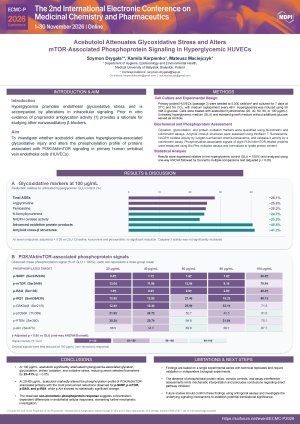
Hyperglycemia promotes endothelial glycoxidative stress and is accompanied by alterations in intracellular signaling. This study investigated whether acebutolol attenuates hyperglycemia-induced glycoxidative injury and alters the phosphorylation of proteins associated with PI3K/Akt/mTOR signaling in human umbilical vein endothelial cells (HUVECs). HUVECs were cultured for 7 days under hyperglycemic conditions induced by 30 mM D-glucose and treated with acebutolol at concentrations of 20–100 μg/mL. Glycation- and glycoxidation-related endpoints, protein oxidation, oxidative stress, caspase-3 activity, and phosphorylation of eight signaling proteins were assessed. Data were normalized to the hyperglycemic control and analyzed using one-way ANOVA followed by Dunnett’s test. At 100 μg/mL, acebutolol significantly reduced markers of glycation, glycoxidation, protein oxidation, and oxidative stress by 23–41% (p < 0.05), including total advanced glycation end products (AGEs), argpyrimidine, pentosidine, N-formylkynurenine, advanced oxidation protein products, amyloid cross-β structures, and NADPH oxidase activity. Caspase-3 activity was not significantly increased. At 20–80 μg/mL, acebutolol significantly altered the phosphorylation of several proteins associated with PI3K/Akt/mTOR signaling. The most pronounced effects were observed for p-S6RP, p-mTOR, p-BAD, and p-IRS1, whose relative phosphorylation signals decreased to 0.7–21.4% of the hyperglycemic control, defined as 100%. Significant reductions were also observed for p-GSK3α/β, p-p70S6K, and p-PTEN, whereas p-Akt was not significantly affected. At 100 μg/mL, reductions in several phosphoproteins were less pronounced than at lower concentrations, indicating a non-monotonic response pattern. Overall, acebutolol attenuated hyperglycemia-associated glycoxidative injury and altered the phosphorylation profile of proteins associated with PI3K/Akt/mTOR signaling in endothelial cells.
Keywords
acebutolol
HUVEC
advanced glycation end products
oxidative stress
mTOR signaling
Poster
NVBB_Poster_Sci.pdf
Can simple UV-Vis measurements with tryptophan serve as a screening model for potential drug-AGP interactions?
Physiologically Based Pharmacokinetic (PBPK) Modelling of a Gastroretentive Cimetidine Formulation: Predicting Enhanced Bioavailability Through Prolonged Gastric Retention.