Event submissions
EventsThe 2nd International Electronic Conference on Medicinal Chemistry and Pharmaceutics
Published
This submission belongs to the session S10. Biopharmaceutics, Disposition, Pharmacokinetics and Pharmacodynamics of the event The 2nd International Electronic Conference on Medicinal Chemistry and Pharmaceutics
Published date
28 Oct, 2026
Academic Editor
 Thierry Vandamme
Citation
VANESSA DANAI BEREJENA, Humphrey Masimba Makumbirofa, Physiologically Based Pharmacokinetic (PBPK) Modelling of a Gastroretentive Cimetidine Formulation: Predicting Enhanced Bioavailability Through Prolonged Gastric Retention., in Proceedings of The 2nd International Electronic Conference on Medicinal Chemistry and Pharmaceutics, 1 November–30 November 2026, MDPI: Basel, Switzerland
Share
Email
Facebook
Twitter
LinkedIn
Physiologically Based Pharmacokinetic (PBPK) Modelling of a Gastroretentive Cimetidine Formulation: Predicting Enhanced Bioavailability Through Prolonged Gastric Retention.

VANESSA DANAI BEREJENA 1

Humphrey Masimba Makumbirofa 2
1. Dispensary Department, Trinity Pharmacy, Harare, Zimbabwe
2. Department of Pharmaceutical Technology, School of Allied Health Sciences, Harare Institute of Technology, Belvedere, Harare, Zimbabwe
Abstract
Introduction
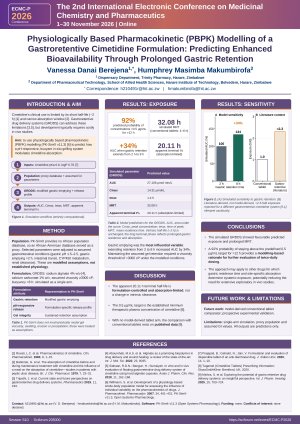
Cimetidine's clinical utility is limited by its short half-life (~2 h) and narrow absorption window. Gastroenteric drug delivery systems (GRDDS) can overcome these limitations, but development typically requires costly in vivo studies. This study used PBPK modelling (PK-Sim® v11.3) to predict how a pH-responsive buoyant in situ gelling system modulates cimetidine absorption.
Methods
Simulations incorporated cimetidine's properties (pKa 6.8, logP 0.78). As PK-Sim® provides no African population database, an African-American database served as a proxy, with selected parameters adjusted to reflect assumed gastrointestinal conditions (gastric pH 1.5–2.5, gastric emptying > 2 h, intestinal transit, CYP450 metabolism, renal clearance); these are modelled assumptions, not established physiology. Gastric retention was modelled by modifying gastric emptying; pH-responsive release was represented by a formulation-specific release profile; and gel integrity was represented as a sustained retention assumption, as PK-Sim® does not mechanistically model viscosity. The GRDDS (sodium alginate 4% w/v, calcium carbonate 1% w/v, assumed viscosity ≥ 3000 cP, buoyancy > 8 h) was simulated as a single arm.
Results
The model predicted a GRDDS AUC of 27,106 µmol·min/L, a Cmax of 14.31 µmol/L, a tmax of 1.4 h, an MRT of 32.08 h (vs 4–6 h for conventional tablets), and an apparent terminal half-life of 20.11 h (absorption-limited, not a change in intrinsic clearance). The model predicted a 92% probability of maintaining plasma concentrations above the established minimum therapeutic level of 0.5 µg/mL for >12 h, providing a modelling-based rationale for further evaluation of twice-daily dosing. Gastric emptying was the most influential variable; extending retention from 2 to 8 h increased AUC by 34%. Because the simulation modelled only the GRDDS formulation, no model-derived comparator was available; published data for gastroretentive cimetidine systems report approximately 2.3-fold increases in systemic exposure relative to conventional tablets (Mishra et al., 2025; Rovati et al., 1983), though direct comparison should be interpreted cautiously.
Discussion
The simulated GRDDS showed favourable predicted exposure and prolonged MRT. Prospective experimental validation, including a model-derived conventional tablet comparator, is required.
Keywords
PBPK
PK‑Sim
cimetidine
pharmacokinetics
gastroretentive
bioavailability
African physiology
Poster
Cimetidine PBPK GRDDS Poster.pdf
Acebutolol Attenuates Glycoxidative Stress and Alters mTOR-Associated Phosphoprotein Signaling in Hyperglycemic HUVECs