Event submissions
EventsThe 2nd International Electronic Conference on Medicinal Chemistry and Pharmaceutics
Published
This submission belongs to the session S2. General of the event The 2nd International Electronic Conference on Medicinal Chemistry and Pharmaceutics
Published date
29 Oct, 2026
Academic Editor
 Maria Emília Sousa
Citation
Reyhaneh Danaeipour, Tayebeh Radjabian , Azra Saboora, Morteza Yousefzadi, Flavonoid-Rich Profiles across Different Populations of Six Iranian Achillea Species, in Proceedings of The 2nd International Electronic Conference on Medicinal Chemistry and Pharmaceutics, 1 November–30 November 2026, MDPI: Basel, Switzerland
Share
Email
Facebook
Twitter
LinkedIn
Flavonoid-Rich Profiles across Different Populations of Six Iranian Achillea Species

Reyhaneh Danaeipour 1
Tayebeh Radjabian 2
Azra Saboora 3
Morteza Yousefzadi 1
1. Department of Biology, Faculty of Basic Science, Qom University, Qom, Iran
2. Department of Biology, Faculty of Basic Sciences, Shahed University, Tehran, Iran
3. Department of Plant Sciences, Faculty of Biological Sciences, Alzahra University, Tehran, Iran
Abstract
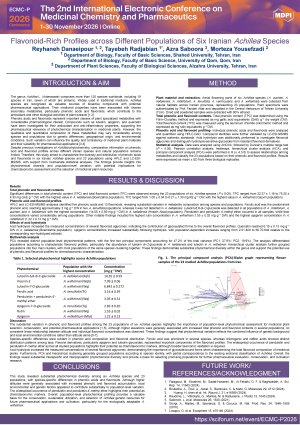
Achillea L. (Asteraceae) is a medicinally important genus with a long history of use in traditional and folk medicine for the treatment of various ailments. The genus is characterized by a diverse and rich phytochemical composition, particularly phenolic compounds and flavonoids, which have been widely investigated for their antioxidant, anti-inflammatory, and antimicrobial properties. Among these constituents, luteolin, apigenin, and their derivatives are of particular interest because of their documented pharmacological properties. The present study aimed to characterize individual phenolic and flavonoid compounds in six Iranian Achillea species and their populations using high-performance liquid chromatography (HPLC). Considerable interspecific and population-level variation was observed in the accumulation of individual metabolites. For example, luteolin 6,8-di-C-glucoside was found to reach its highest content (14.55 mg g⁻¹ dry weight) in A. kellalensis, while vicenin-2, an apigenin C-glycoside, exhibited 7.09 mg g⁻¹ dry weight in A. wilhelmsii. Several A. wilhelmsii populations showed particularly high levels of apigenin-derived flavonoids, including vicenin-2, vitexin, and apigenin-7-O-glucoside. In contrast, compounds such as luteolin, quercetin, and kaempferol exhibited varied distribution patterns among the evaluated species. The observed diversity in flavonoid profiles underscores the potential of Iranian Achillea as a source of pharmacologically relevant compounds. Consequently, the chemically enriched species and populations identified may serve as promising plant material for targeted compound isolation, bioactivity-guided screening, and further pharmacological and pharmaceutical research.
Keywords
Achillea
Apigenin
Luteolin
medicinal plant
Poster
Danaeipour-2026.pdf
Physiologically Based Pharmacokinetic (PBPK) Modelling of a Gastroretentive Cimetidine Formulation: Predicting Enhanced Bioavailability Through Prolonged Gastric Retention.
Molecular Docking Investigation of Glabridin Interaction with the VC1 Domain of RAGE