Event submissions
EventsThe 2nd International Electronic Conference on Medicinal Chemistry and Pharmaceutics
Published
This submission belongs to the session S4. Natural Products and Biopharmaceuticals of the event The 2nd International Electronic Conference on Medicinal Chemistry and Pharmaceutics
Published date
29 Oct, 2026
Academic Editor
 Alfredo Berzal-Herranz
Citation
Mozhgan Omidi, Molecular Docking Investigation of Glabridin Interaction with the VC1 Domain of RAGE, in Proceedings of The 2nd International Electronic Conference on Medicinal Chemistry and Pharmaceutics, 1 November–30 November 2026, MDPI: Basel, Switzerland
Share
Email
Facebook
Twitter
LinkedIn
Molecular Docking Investigation of Glabridin Interaction with the VC1 Domain of RAGE

Mozhgan Omidi 1
1. Independent Researcher, Tehran, Iran
Abstract
Background: Receptor for advanced glycation end products (RAGE/AGER) is a multifunctional cell-surface receptor implicated in inflammatory and disease-associated signaling. Glabridin, a bioactive isoflavan isolated from licorice, has attracted interest because of its reported biological activities. However, its potential interaction with RAGE remains insufficiently characterized at the molecular level.
Objective: This study aimed to investigate the potential binding of glabridin to the VC1 domain of human RAGE using molecular docking and interaction analysis, with structural validation of the docking protocol.
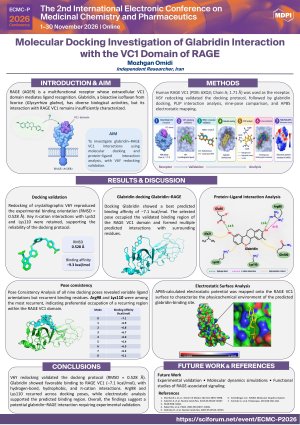
Methods: The crystal structure of the RAGE VC1 domain (PDB ID: 6XQ3; Chain A; 1.71 Å) was used as the receptor. The crystallographic ligand V6Y was redocked using AutoDock Vina through PyRx for protocol validation. The redocked V6Y pose was compared with the experimental conformation using RMSD and protein–ligand interaction analysis. Glabridin was subsequently docked into the validated binding region. The top-ranked pose was analyzed using PLIP, and nine docking poses were compared to assess binding-region consistency.
Results: V6Y redocking reproduced the experimental binding orientation with an RMSD of 0.528 Å and a predicted affinity of −9.3 kcal/mol. Key π-cation interactions involving Lys52 and Lys110 were retained. Glabridin showed a best predicted affinity of −7.1 kcal/mol. The selected pose formed hydrogen bonds with Glu50 and Arg98, hydrophobic contacts with Ala21, Lys52, Arg98, Gln100, and Lys110, and a π-cation interaction with Arg98. Arg98 and Lys110 recurred across the nine poses despite differences in ligand orientation.
Conclusion: These findings support a potential glabridin–RAGE VC1 interaction and identify a recurrent binding region warranting further experimental investigation.
Keywords
Glabridin; Molecular docking; Protein–ligand interactions; RAGE; VC1 domain
Poster
Powepoint(Poster).pdf
Flavonoid-Rich Profiles across Different Populations of Six Iranian Achillea Species
In vivo genotoxicity assessment of selected compounds for the development of HDAC4-targeting PROTACs in spinal muscular atrophy