Event submissions
EventsThe 2nd International Electronic Conference on Medicinal Chemistry and Pharmaceutics
Published
This submission belongs to the session S2. General of the event The 2nd International Electronic Conference on Medicinal Chemistry and Pharmaceutics
Published date
29 Oct, 2026
Academic Editor
 Alfredo Berzal-Herranz
Contribution&Funding
Conceptualization,
[Milan Mladenović]
Methodology,
[Nevena Tomašević] ; [Milan Mladenović] ; [Sanja Lj Matić] ; [Vladimir Savić] ; [Milena R Simić] ; [Predrag Jovanović] ; [Gordana Tasić]
Software,
[Milan Mladenović]
Investigation,
[Sanja Lj Matić]
Resources,
[Predrag Jovanović] ; [Milena R Simić] ; [Gordana Tasić] ; [Vladimir Savić]
Data curation,
[Sanja Lj Matić]
Writing - original draft,
[Milan Mladenović] ; [Nevena Tomašević] ; [Sanja Lj Matić]
Writing - review,
[editing] ; [Sanja Lj Matić] ; [Nevena Tomašević] ; [Milan Mladenović]
Visualization,
[Sanja Lj Matić]
Supervision,
[Milan Mladenović]
Project administration,
[Milan Mladenović]
Funding: This research was supported by the Science Fund of the Republic of Serbia, #GRANT No 7490, Artificial Intelligence-Guided Design, Synthesis, and Pharmacological Evaluation of Innovative PROTACs as Degraders of HDAC4, an Epigenetic Target for Spinal Muscul
Citation
Nevena Tomašević, Gordana Tasić, Predrag Jovanović, Milena R Simić, Vladimir Savić, Sanja Lj Matić, Milan Mladenović, In vivo genotoxicity assessment of selected compounds for the development of HDAC4-targeting PROTACs in spinal muscular atrophy, in Proceedings of The 2nd International Electronic Conference on Medicinal Chemistry and Pharmaceutics, 1 November–30 November 2026, MDPI: Basel, Switzerland
Share
Email
Facebook
Twitter
LinkedIn
In vivo genotoxicity assessment of selected compounds for the development of HDAC4-targeting PROTACs in spinal muscular atrophy

Nevena Tomašević 1

Gordana Tasić 2
Predrag Jovanović 2
Milena R Simić 2
Vladimir Savić 2
Sanja Lj Matić 3

Milan Mladenović 1
1. Kragujevac Center for Computational Biochemistry, Faculty of Science, University of Kragujevac, Kragujevac, 34000, Serbia
2. Department of Organic Chemistry, University of Belgrade, Faculty of Pharmacy, Belgrade, 11221, Serbia
3. Department of Science, University of Kragujevac, Institute for Information Technologies Kragujevac, Kragujevac, 34000, Serbia
Abstract
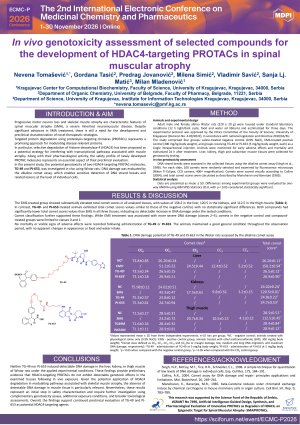
Progressive motor neuron loss and skeletal muscle atrophy are characteristic features of spinal muscular atrophy (SMA), a severe inherited neuromuscular disease. Despite significant advances in SMA treatment, there is still a need for the development and preclinical characterization of novel therapeutic strategies. Targeted protein degradation using proteolysis-targeting chimeras (PROTACs) represents a promising approach for modulating disease-relevant proteins. In particular, selective degradation of histone deacetylase 4 (HDAC4) has been proposed as a potential strategy for interfering with transcriptional pathways associated with muscle atrophy. Along with their pharmacological activity, the safety profile of newly developed PROTAC molecules represents an essential aspect of their preclinical evaluation. In the present study, the potential genotoxicity of two HDAC4-targeting PROTAC molecules, TG-49 and PJ-653, was investigated in vivo using Wistar rats. DNA damage was evaluated by the alkaline comet assay, which enables sensitive detection of DNA strand breaks and related lesions at the level of individual cells. Animals treated with ethyl methanesulfonate (EMS), a well-established genotoxic agent, were included as a positive control, while an appropriate untreated control group was used for comparison. Neither TG-49 nor PJ-653 induced significant DNA damage in the liver, kidney, or femur samples compared with the control groups, indicating that the investigated compounds did not exhibit detectable genotoxic effects in the evaluated tissues under the applied in vivo conditions. The obtained results contribute to the safety characterization of TG-49 and PJ-653 and provide additional information relevant to their further preclinical development as potential HDAC4-targeting agents for SMA.
Keywords
spinal muscular atrophy
in vivo
DNA damage
comet assay
Wistar rat
Poster
Tomasevic et al ECMC-P 2026.pdf
Molecular Docking Investigation of Glabridin Interaction with the VC1 Domain of RAGE
“Development and Characterization of a High-Fat High-Sucrose Dietary Model of Obesity in Wistar Rats”